The History of Love Hotels in Japan: From Tsurekomi-Yado to “Item 4”
Japan has no statute called the “love hotel act,” and until February 1985 it had no legal category for one either. What it had, from July 1948, was an inn-licensing law written on the public-health side of government — and the history of the love hotel is largely the history of what officials did with that law when they could not reach the business any other way.
That is not how the story is usually told in English. The most visible accounts open in the Edo period with “meeting tea-houses,” jump to a hotel in Osaka in 1968, and arrive at a themed building in Tokyo in the 1970s. We went looking for those claims in Japanese government records and could not stand any of them up, so this article does not repeat them. What we could stand up is a paper trail: four statutes promulgated in one week of 1948, an amendment in June 1957 that split the licenses and drew a line around schools, a word that entered the national legislature in 1978, and a legal category that came into force on a date a Cabinet Order states in its own parentheses.
Everything below is dated from the government’s own machine-readable statute text, from the government English translations where they exist, and from the National Diet Library’s searchable record of parliamentary committee proceedings — a source that, as far as we can tell, no English-language account of this subject has used. This is the history; for how one of these hotels works when you walk into it today, see how a Japanese love hotel actually works.
A timeline you can check
Every date in this table comes from the statute itself or from a dated committee record, and the section that follows each one shows the working. Nothing here is dated from a secondary account.
| Date | What happened | Where we read it |
|---|---|---|
| July 10, 1948 | The amusement business law is promulgated as Act No. 122 of 1948 | Statute text, e-Gov |
| July 12, 1948 | Three public-health statutes are promulgated on one day: the Entertainment Places Act (No. 137), the Hotel Business Act (No. 138) and the Public Bath Houses Act (No. 139) | Statute text, e-Gov |
| July 15, 1948 | All three come into force | Each Act’s own supplementary provisions |
| May 24, 1956 | The Anti-Prostitution Act is promulgated as Act No. 118 of 1956 | Statute text, e-Gov |
| April 1, 1957 | That Act comes into force, except its Chapter 2 | Its supplementary provisions |
| June 15, 1957 | Act No. 176 of 1957 amends the Hotel Business Act, creating four license categories; in force the same day | Supplementary provisions to the amendment |
| April 1, 1958 | Chapter 2 comes into force; local ordinances punishing prostitution lose their effect | Its supplementary provisions |
| February 2, 1962 | The word “motel” appears in the Diet record for the first time — in a proposal to promote motels | Diet committee record |
| April 11, 1978 | The word “love hotel” appears in the Diet record for the first time | Diet committee record |
| August 14, 1984 | Act No. 76 of 1984 is promulgated, rewriting the amusement business law | Statute text, e-Gov |
| November 7, 1984 | Cabinet Order No. 319 of 1984 is promulgated | Order text, e-Gov |
| February 13, 1985 | Both come into force; the love hotel exists as a legal category for the first time | The Cabinet Order’s own supplementary provision |
| June 15, 2018 | The inn and hotel categories created in 1957 are merged into one | Statute text and revision record, e-Gov |
| December 13, 2023 | The grounds for refusing a guest are rewritten; the register changes | Statute text and revision record, e-Gov |
July 1948: four statutes in one week
The occupation-era Diet passed a great deal of law in the summer of 1948, and four of those statutes between them still govern most of what this site writes about. Read in sequence, their promulgation dates and act numbers tell you something that no narrative account does.
| Act | Number | Promulgated | In force | What it licenses |
|---|---|---|---|---|
| Amusement business law (the Fueiho) | Act No. 122 of 1948 | July 10, 1948 | — | Cabarets, dance halls and similar trades |
| Entertainment Places Act | Act No. 137 of 1948 | July 12, 1948 | July 15, 1948 | Theaters, cinemas, variety halls |
| Hotel Business Act | Act No. 138 of 1948 | July 12, 1948 | July 15, 1948 | Inns, hotels, lodging houses |
| Public Bath Houses Act | Act No. 139 of 1948 | July 12, 1948 | July 15, 1948 | Bathhouses |
Three consecutive act numbers, promulgated the same day, in force the same day. They are not merely adjacent: they are drafted alike. Each of the three carries a transitional provision in identical form, giving anyone who had started that business between January 1, 1948 and the day the law took effect two months to file a notification, after which they were treated as licensed. The drafters expected to find a lot of new inns, new theaters and new bathhouses already operating — and wrote a clause to sweep them in.
This matters for the love hotel because of what the Hotel Business Act is. It is a sanitation statute. Article 3 requires a license from the prefectural governor — or, in a city that runs its own public health center and in Tokyo’s special wards, from the mayor or ward head. Article 4 is about ventilation, natural and artificial lighting, damp-proofing and cleanliness. The authority is the health side of government, not the police. A Japanese love hotel is, first and before anything else, a licensed inn under a 1948 public-health law. Its legal ancestor is the same statute that licenses a family hot-spring ryokan.
The other two statutes went on to define the categories of the sex trade directly. When the amusement business law was rewritten in 1984, it defined the soapland by pointing at the Public Bath Houses Act and the strip theater by pointing at the Entertainment Places Act — we trace the second of those in the history of the Asakusa strip theaters. The love hotel category, as we will see, was defined differently.
What the record actually called them
There was no word “love hotel” in 1948. The thing that existed was the tsurekomi-yado — literally a “bring-along inn” — and its close variant tsurekomi-ryokan. Both appear in the record of Japan’s national legislature, and both are now extinct there: the National Diet Library’s full-text search returns 28 uses of the first and 27 of the second across the whole postwar record — and after 1989 the first never appears again, while the second appears exactly once, in a town-planning hearing in May 2000.
The upside-down jellyfish
The period slang is better than the formal term, and it survives in the official record too. Inns of this kind advertised with the hot-spring mark, the pictogram of a bath with three curls of steam rising from it, and the nickname they acquired was sakasa-kurage — the upside-down jellyfish. The usual explanation is that the mark seen upside down reads as a jellyfish trailing tentacles. We found the term used freely in official proceedings but no government source that explains its derivation, so treat the etymology as the received account rather than a documented one.
This was not street slang that officials avoided. A member of the House of Representatives used it in a budget subcommittee on February 22, 1956, pairing it with “hot-spring mark” as if both needed no explanation. Nineteen years later, on May 22, 1975, an official of the National Police Agency’s crime-prevention section used it himself in a Cabinet Committee session, telling members that what had collected in districts like Kabukicho was not motels but “what you might call the upside-down jellyfish — tsurekomi-ryokan.” When a police bureau reaches for the slang in committee, the slang has become the working category.
The inversion belonged to a particular decade.
Filed as a hygiene problem, not a vice problem
Here is the finding that reorganized this article. The earliest appearance of tsurekomi-yado anywhere in Japan’s parliamentary record is July 21, 1951 — and it is not in a judicial affairs committee or a police matter. It is in the House of Representatives Committee on Health and Welfare, in a complaint about bathing facilities.
A member told the committee that supervision of bathhouses nationwide was not reaching far enough, described hot-spring inns and restaurant-inns that had taken on “bring-along” custom, and asked the bureau chief to issue fresh instructions to the field offices so that inspection of inns, restaurant-inns, hot springs and bathhouses would be properly carried out. The frame is environmental hygiene. The remedy sought is sanitary inspection. That is the committee the subject belonged to, because the Hotel Business Act was the only lever anyone had.
The vocabulary stayed in that register as the national argument over prostitution came to a head. In the House of Representatives Judicial Affairs Committee on March 13, 1954, during the long run-up to prohibition, a member said there was no city in the country without these inns, and that respectable old lodging houses had been converted into them behind thin camouflage. In the budget subcommittee of February 22, 1956, another member put the number of such premises licensed in Tokyo at four thousand-odd, saying he had heard the figure was about 4,400, and tied the question directly to the prostitution bill then before the Diet.
We flag that 4,400 as what it is: a figure a legislator said he had been told, with no source attached, and we will not launder it into a statistic. What the record does establish is the shape of the problem as officials saw it in 1956 — a very large number of ordinary inn licenses doing something the inn law had not been written for.
June 15, 1957: the licenses split, and a line is drawn around schools
Then the government used the lever. On June 15, 1957, Act No. 176 of 1957 amended the Hotel Business Act, and it came into force the day it was promulgated.
One license becomes four
The amendment’s own transitional clause gives away what it did. It provides that anyone already licensed under the old Article 3 is deemed, according to the form of their business, to hold a license in one of four new classes: hoteru eigyo, ryokan eigyo, kan-i shukusho eigyo and geshuku eigyo — roughly, Western-style hotel operation, Japanese-style inn operation, common lodging house operation and boarding house operation. (The government English translation of this Act renders only the classes that exist today, so those four descriptions are ours.) None of the four existed before. The 1948 Act had a single, undifferentiated license for the whole trade; from June 1957 the state could sort licensees into classes and write different structural standards for each. To regulate a type of lodging, you first have to be able to name it.
“Innocent institutional environment”
The same amendment appears to have inserted the clause that has shaped the geography of this business ever since. Today, Article 3, paragraph 3 of the Hotel Business Act lets the licensing authority refuse a license when the proposed facility would sit within “roughly 100 meters of the grounds” of a school, a certified pre-school or daycare center, a child welfare institution, or a social-education facility named by local ordinance, and the authority finds that putting it there “would risk significantly marring the innocent institutional environment” of that institution. Those are the words of the government English translation; the Japanese adjective is seijun, pure or chaste.
Paragraph 4 goes further than a veto. Before granting a license inside that 100-meter band, the authority must first seek the opinion of a named outsider: the university president, the principal of the college of technology, the local board of education, the head of the local government for a pre-school, or the administrative authority under the Child Welfare Act. A school is given a formal voice in a hotel licensing decision.
For the purpose of that clause we have a contemporaneous statement on the record. In the House of Representatives Education Committee on March 14, 1958, a member recalled that an amendment to the Hotel Business Act had been made on June 15 of the previous year — a date he gave from memory — and said its intent was that the educational environment of a school must be seijun, so that the construction of tsurekomi-ryokan and other dubious premises near a school ought not to be permitted. He named the trigger as the controversy over the surroundings of a Tokyo elementary school the previous year, and complained that the point of the new provision had not been driven home to the prefectures and the five large cities.
One earlier record points the same way. Three months before the amendment, on March 5, 1957, an expert witness told the House of Councillors Education Committee that most of the hot-spring-mark inns around that same school were couples’ inns, and that the marks themselves had by then been taken down under a trade-association agreement.
We are careful about the attribution here: that is a legislator’s account of the amendment’s purpose, given nine months after it passed, not a statement in the statute. The date he gives matches the promulgation date of Act No. 176 exactly. What we cannot do is diff the 1957 text against the 1948 text, because the government’s revision database only holds versions of this Act back to 2017.
Two features of modern Japanese hotel law fall out of the same design. Article 3, paragraph 6 allows the authority to attach to a license “the conditions that are necessary from a public health standpoint or from the perspective of upholding public policy” — morals conditions on a sanitation permit. And Article 7-2, paragraph 2 lets the governor order an operator to take measures where needed to prevent the business from encouraging or inducing acts injurious to public morals. A health statute with a morals engine inside it.
What 1958 did, and what it did not do
The Anti-Prostitution Act was promulgated on May 24, 1956 as Act No. 118 of 1956, and its supplementary provisions set a two-stage clock: the Act came into force on April 1, 1957, except for Chapter 2 — the penal chapter — which was held back to April 1, 1958. A fourth paragraph of the same supplementary provisions did something easy to miss: local ordinances that punished prostitution lost their effect at the moment Chapter 2 came into force, so the national scheme replaced a patchwork rather than adding to it. We tell that story properly in 1958, the year Japan closed the red lines and in the red lines and blue lines on a policeman’s map.
Two things are worth stating plainly about the relationship between that closure and the love hotel.
The first is chronology. The licensed quarters whose history runs from Edo to 1958 — traced in three hundred years of Yoshiwara, and distinguished from the world of the performing arts in the difference between an oiran and a geisha — were not the thing the 1957 inn amendment was aimed at. The inn amendment came nine and a half months before the penal chapter bit. By the time the red lines closed, the state had already reclassified every inn in the country and given schools a veto within 100 meters. Officials were not reacting to 1958; they were ahead of it.
The second is restraint. English accounts routinely assert that the 1958 closure created the love hotel by pushing demand into ordinary inns. That is a plausible story for which we have no primary evidence. What we can say is narrower and better attested: the tsurekomi-yado existed before 1958, was already understood as a national problem before 1958, and was already being regulated through the inn statute before 1958. Where the trade of the former quarters actually went is handled in the articles above, and in the postwar comfort facilities of 1945 for the period before them.
1962 to 1966: the motel arrives as Olympic infrastructure
The next chapter is the best-documented reversal in this history, and we have not seen it told anywhere in English.
The word “motel” does not appear in Japan’s parliamentary record before 1962. Its first appearance is February 2, 1962, in the House of Representatives Committee on Local Administration — and it is a member asking the government to encourage them. Noting that a terminal act had passed the previous year, he said that to take the idea further to the general public “a motel bill” was needed, and asked whether the ministry was considering one.
Through 1962 the word keeps that sense. In a budget subcommittee on March 27, 1962, motels are discussed beside youth hostels as the sort of cheap accommodation Japan would need for the visitors coming to the 1964 Tokyo Olympics — somewhere a young traveler could park a car and sleep for six to eight dollars. In the special committee on Olympic preparations on October 31, 1962, a member described American hotels that had bought large sites near airports so guests could drive straight to the door, “a motel-style hotel,” and suggested Japan would need to think the same way.
Four years later the meaning had inverted. In the House of Representatives special committee on prices on March 9, 1966, a member of the governing party raised motels twice. The second time he explained why they were so profitable: because they become tsurekomi-yado. You drive a woman out there, he said, and rest a while.
So the motel was imported as public motoring infrastructure, proposed for its own statute, recruited to the Olympic accommodation shortage — and repurposed so fast that within four years the legislature was discussing it as the car-borne successor to the bring-along inn. The 1975 police explanation quoted earlier describes what followed: motels had originally been built along national highways rather than in entertainment districts, area restrictions were imposed because they were held to damage the surrounding environment, and in that official’s assessment the restrictions worked. The same official was careful to keep the two things apart. What had collected in districts like Kabukicho was not motels, he said, but bring-along inns — and the hard part, in his account, was how to tell premises like those from ordinary hotels as a matter of law or administration at all, which left the police policing prostitution and other offenses inside them instead. That distinction is the problem the 1984 Act would eventually try to settle with a tape measure. For the district itself, see how Kabukicho became Kabukicho.
Counting the words: how the official vocabulary changed
Because the parliamentary record is fully searchable from 1947, the change of vocabulary can be counted rather than described. We ran each term against the National Diet Library’s speech database on November 2, 2026 and bracketed the results by decade. The table is the whole postwar record, both chambers, every committee. One caution about method, because it changed two of the numbers: the search ignores punctuation, so a hit is not always a use. We pulled the full text of all 781 hits and checked each one for the exact string. Every hit held it except a December 1979 speech in which kurabu, hoteru — “a club, a hotel” — had matched rabu hoteru across a comma. The figures below are the verified counts rather than the raw hit counts, and for the tea-house we searched four spellings instead of one.
| Term | Total | 1947–59 | 1960s | 1970s | 1980s | 1990s | 2000s | 2010–26 |
|---|---|---|---|---|---|---|---|---|
| tsurekomi-yado (bring-along inn) | 28 | 9 | 9 | 7 | 3 | 0 | 0 | 0 |
| tsurekomi-ryokan | 27 | 2 | 9 | 15 | 0 | 0 | 1 | 0 |
| moteru (motel) | 490 | 0 | 57 | 339 | 77 | 8 | 8 | 1 |
| rabu hoteru (love hotel) | 230 | 0 | 0 | 2 | 79 | 12 | 80 | 57 |
| dohan-ryokan (accompanying inn) | 5 | 0 | 0 | 3 | 2 | 0 | 0 | 0 |
| deai-chaya (meeting tea-house) | 1 | 1 | 0 | 0 | 0 | 0 | 0 | 0 |
Read down the columns and the handover is unmistakable. The bring-along inn is a 1950s and 1960s word that dies after the 1980s. The motel owns the 1970s with 339 mentions and then collapses. The love hotel does not exist in the record before 1970, barely registers in the 1970s, and then jumps to 79 mentions in the 1980s — the decade in which, as the next section shows, it acquired a legal definition.
Where the phrase “love hotel” entered the record
Both 1970s uses are worth looking at individually, because of how casual they are. The earliest is April 11, 1978, in the House of Councillors Transport Committee, and the subject is not hotels at all: a member discussing how textile firms had survived by switching trades listed, among the examples, moving abruptly into “something like a love hotel, a cash business.” On February 28, 1979, in a budget subcommittee, a member complained about school architecture by saying it would be a problem if people thought that building “something like a love hotel” counted as artistic merit.
Neither speaker explains the term. Both assume every colleague in the room knows it. That tells you the word was ordinary Japanese well before 1978 — the Diet record gives us the date the phrase reached the legislature, which is a floor, not a birthday. Where exactly it came from, we could not establish, and we say so below rather than borrowing an answer.
1984: the year “love hotel” became a legal category
The amusement business law of 1948 said nothing about hotels. The statute that did was Act No. 76 of August 14, 1984, which rewrote it from top to bottom, gave it the name it carries today, and created the scheme of store-based sex-related businesses described in our explainer on what the Fueiho is. The same bill is the one that forced the renaming of the Turkish baths, a story we tell in from Turkish bath to soapland.
The commencement date is stated in an unusual place. Act No. 76 said only that it would come into force on a day fixed by Cabinet Order within six months of promulgation. Cabinet Order No. 319 of 1984, promulgated on November 7, 1984, then states in its own first supplementary provision that it takes effect on the day the amending Act comes into force — and gives that day, in parentheses, as February 13, 1985. The Order dates the Act.
Item 4 of the new list of store-based sex-related businesses is the love hotel. In the official English it is a business that runs “accommodation facilities specified by Cabinet Order to be mainly used to accommodate (including rest …) customers accompanied by the members of the opposite sex for the stay,” limited to facilities with private rooms whose structure or equipment is also specified by Cabinet Order.
Two things about that wording are worth measuring, and we measured them in the original Japanese rather than in translation. Across the whole operative text of the Act, the expression isei o doban — accompanied by a person of the opposite sex — appears exactly once, and kyukei, rest, appears exactly once. Both are in item 4. In an Act of some ninety-nine articles governing every licensed night trade in Japan, the vocabulary of the love hotel occupies a single sub-item. And the words rabu hoteru and moteru appear in that operative text zero times. The English word attaches somewhere else entirely: the National Police Agency labels this category, in its published statistics, as item 4 business (love hotels etc.). That heading, not the statute, is where the familiar name lives. The government English translation of the Act contains the phrase “love hotel” zero times as well; we checked that side too.
The test that decides whether a given building falls inside item 4 lives entirely in Article 3 of that Cabinet Order, and it is a checklist of architectural features — a lobby below a floor-area threshold, rest prices visible from the street, screening at the entrance, an obstructed front desk, keys from a machine — each paired with a listed structure or piece of equipment. We work through it clause by clause, with the consequences for what a visitor sees, in our guide to using one, and we are not going to duplicate it here. The historical point is simpler: from February 13, 1985, whether a hotel was a “love hotel” stopped being a matter of description and became a matter of measurement.
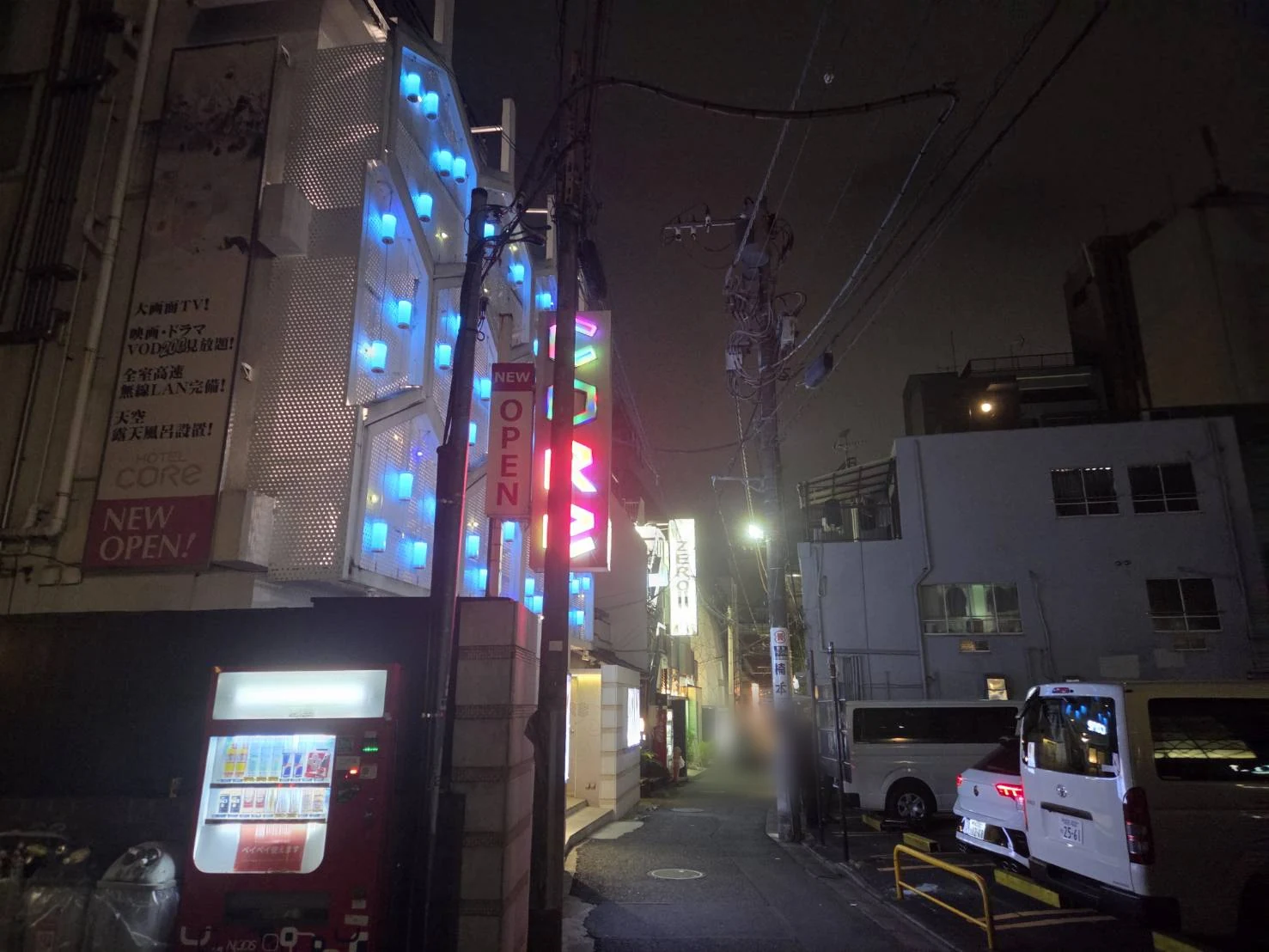
The legislative debate shows the older vocabulary still in use right up to the change. In the House of Councillors Committee on Local Administration on July 24, 1984, three weeks before promulgation, a member pressed the government on why the bill’s advertising and signage provision was only directory rather than enforceable, observing that what it was aimed at was the garish signboards of the Turkish baths and the tsurekomi-yado. The law that created the category “love hotel” was argued over in the language of the bring-along inn.
Two doors into the same building
The 1984 scheme did not replace the Hotel Business Act. It stacked on top of it, and the way the two fit together is the single most useful thing to understand about this business.
Item 4 is defined without reference to the inn law
Look at how the neighboring items are built. Item 1, the soapland, is defined by pointing at the Public Bath Houses Act — Act No. 139 of 1948. Item 3, the strip theater, is defined by pointing at the Entertainment Places Act — Act No. 137 of 1948. Item 4, the love hotel, points at no statute at all: it goes straight to a Cabinet Order. Of the three sanitation laws promulgated together on July 12, 1948, the definitions pick up the first and the third by name and skip the middle one.
But the inn law is where the sanction lands
The Hotel Business Act does appear in the Act — twice, and the important place is Article 30, paragraph 3. When a Public Safety Commission orders a store-based sex-related business under item 1, item 3 or item 4 to suspend or close, it may also order a suspension, for up to eight months, of the underlying licensed business carried on in the same premises: the bathhouse business under the Public Bath Houses Act, the entertainment place business under the Entertainment Places Act, the hotel business under Article 3, paragraph 1 of the Hotel Business Act, or the housing accommodation business under the 2017 home-sharing law.
So the architecture is explicit in the text. Each of those three categories is a police notification sitting on top of a health license, and the police can reach through the notification to the license underneath. That is why nothing about a love hotel can be understood from one statute alone, and it is the same two-authority pattern we describe for the whole sector in every category of Japan’s night industry on one map.
And zoning law never learned the word
One more absence is revealing. We searched the whole of the Building Standards Act, the statute behind Japan’s land-use zones, for the two Japanese expressions that carry the love hotel in the amusement business law. Isei o doban appears zero times. Kyukei no yo ni kyosuru — used for rest — appears zero times. The love hotel has no use class of its own: Appended Table 2 knows only hoteru mata wa ryokan, hotels or inns, as a single undivided category. It names them twice — in the list of what may not be built in the second-class mid-to-high-rise residential zone, and in the list for the industrial zone — and reaches them everywhere else exactly as it reaches any other lodging. The quietest residential zones are drawn the other way round, as lists of what may be built, and a hotel is not on them.
Yet that same table does carry a bespoke class for a soapland. It creates a category it calls koshitsu-tsuki yokujo-gyo, the private-room bath business, defines it by reaching across to item 1 of the amusement business law, then excludes it from the lowest-density residential zone and bars it from neighborhood commercial and quasi-industrial zones. National zoning law singles out one Fueiho category by name and has never created a slot for the largest one. That is not an accident of timing. Act No. 76 of 1984 amended the Building Standards Act as well, which that Act’s own list of amendments records: the drafters had the zoning table open in the same session in which they wrote item 4, and left it with a class for the soapland and none for the love hotel. That gap is a large part of why love-hotel control in Japan has been fought through prefectural and municipal ordinances rather than through the planning system — and why, in Tokyo, the sharpest geographic limits on these hotels sit in a metropolitan ordinance rather than a national statute.
The split still shows at the front desk today: an ordinary licensed hotel keeps a guest register and treats a second person as a second guest, which is why whether you can bring a visitor to your hotel room in Japan is settled by the hotel’s own house rules rather than by the statute.
2018 and 2023: the 1957 categories are abolished
The last chapter is recent, and it closes a loop opened in this article’s middle.
The four categories become three
Act No. 84 of December 15, 2017 amended the Hotel Business Act, and the amendment came into force on June 15, 2018. Its transitional provision states that anyone licensed under the old Article 2, paragraph 2 (hoteru eigyo) or under the old paragraph 3 (ryokan eigyo) is deemed to hold a license in a single merged class, which the government translation now calls “the business of operating an inn or hotel”. We confirmed the effect directly: ryokan eigyo as a standalone class appears zero times in the current operative text, and Article 2 now lists three kinds of hotel business where it once listed four.
The distinction created on June 15, 1957 to let the state sort lodging houses into classes was abolished, after sixty-one years, in the same legislative season that Japan brought home-sharing inside the law. The two moves belong together: the 2017 home-sharing act is the one that turns up in the Fueiho’s suspension clause beside the bathhouse, the theater and the inn.
The register stops asking what you do for a living
Act No. 52 of June 14, 2023 came into force on December 13, 2023 and rewrote the guest-facing provisions. Two changes are visible if you compare the current Japanese text with the government English translation, which is still only current to the 2017 amendment.
First, the register. Article 6 used to require a licensed hotel to record the “names, addresses, and occupations of the lodgers” — those are the government translation’s words. The current text requires name, address and contact details. Your occupation came off the form; a way to reach you went on. It is a small amendment that says a lot about what a guest register is now for. The register itself is old and still has teeth in both directions: a guest who gives false particulars commits an offense punishable by “penal detention or a petty fine” under Article 12. We cover what a hotel may and may not ask, and what it does with the answers, in the rules on hotel guests in Japan.
Second, refusal. Article 5 still opens with the rule that a licensed hotel must not turn a guest away, and still lists the exceptions — but the list was reworked, the old reference to a person who “has an infectious disease” replaced by a defined set of specified infectious diseases, and a new ground added for a guest who repeatedly makes demands so burdensome that service to other guests would be seriously obstructed. The 2023 Act also carries a review clause instructing the government to examine how the new Article 5 works in practice, in light of the fact that the old provision had been used to discriminate unjustly against people who had had Hansen’s disease. It is rare for a statute to write its own history of misuse into its supplementary provisions.
Looking at these districts today
Most of the places in this history are ordinary working neighborhoods where people live, and the buildings are businesses, not exhibits. Photograph streets rather than doorways and guests, and keep in mind one practical rule that has nothing to do with history: as a general matter, do not follow anyone who approaches you on the street offering to lead you somewhere, however helpful the offer sounds. We explain why, and what to say, in why you should not follow touts in Japan. If you are trying to understand the modern geography rather than the history — which districts hold what, and why the business splits between premises and dispatch — start with incall and outcall in Tokyo.
What we could not confirm
The leading English-language accounts of this subject rest on four claims we could not verify, and we have left all four out of the history above rather than passing them along. Each is reported below with what we actually checked.
- That love hotels descend from Edo-period “meeting tea-houses.” This is the opening move of the highest-ranking English results. We cannot test a seventeenth-century claim against a parliamentary record that begins in 1947, so absence there would prove nothing about Edo — but the record is not quite silent. Across four spellings, deai-chaya appears exactly once in the whole postwar record: on March 5, 1957, an expert witness told the House of Councillors Education Committee that before the war there had been deai-chaya in Mukojima in Tokyo, and that the postwar equivalent had become enormously popular. Someone drew that continuity in a government committee a generation before the English-language accounts did. What nobody has shown us is the step from a witness’s aside to a documented line of descent — and the lineage plays no part in how the business has actually been regulated. Every regulatory thread we could follow starts in 1948.
- That the first love hotel was the “Hotel Love,” which opened in Osaka in 1968. We found this stated on a personal publishing platform in the search results and repeated elsewhere. We could find no government record of it: zero hits in the parliamentary database for the name. We have no basis to print a founding hotel or a founding year.
- That a themed hotel in Meguro in the early 1970s was the first of the modern kind. Variants of this appear in the English results, with the date given as 1972 or 1973 depending on the source. The name returns zero hits in the parliamentary record, and we found no official document naming the building. We have not printed a date for it.
- That the term “love hotel” was coined in the late 1960s. Plausible, and consistent with the way the phrase is used without explanation when it first reaches the Diet in April 1978. But a first appearance in the legislative record is a latest-possible date, not an origin. We could not find a datable first use anywhere in a source we were able to open, so we have given the 1978 figure for what it is and no more.
Two further gaps are ours rather than the field’s. We established that Act No. 76 of 1984 amended the Hotel Business Act and the Building Standards Act as well as the Fueiho, and that each of those statutes carries the same commencement clause for it — a Cabinet Order date within six months of August 14, 1984, which Cabinet Order No. 319 then fixed at February 13, 1985. What we could not determine is which provisions of the inn law that Act changed, because the government’s revision database holds versions of that Act only back to 2017. And we could not verify from the statute alone that the 100-meter school clause was inserted in 1957; for that we rely on a legislator’s description of the amendment’s purpose in March 1958, attributed as such above.
Frequently asked questions
When did love hotels start in Japan?
There is no single start date, and the honest answer depends on which question you mean. The business of letting a room by the hour to a couple is documented in Japan’s parliamentary record from 1951, under the name tsurekomi-yado. The statute these hotels are licensed under dates from July 12, 1948. The phrase “love hotel” reaches the national legislature in 1978. And the love hotel exists as a legal category only from February 13, 1985. Anyone who gives you one founding year is answering a different question from the one you asked.
Why are love hotels legal in Japan?
Because they are hotels. Every one of them holds a license under the Hotel Business Act of 1948, granted by the public-health side of government, and that license is what makes the business lawful. A subset additionally falls into item 4 of the amusement business law and files a notification with the prefectural Public Safety Commission — a filing, not a permission. Nothing in either statute makes using one an offense.
What were love hotels called before they were called love hotels?
Tsurekomi-yado or tsurekomi-ryokan, the “bring-along inn,” and colloquially the sakasa-kurage — the upside-down jellyfish, after the inverted hot-spring symbol on the signs. In the 1970s the dominant word in official use was simply “motel.” All three terms have effectively vanished from Japan’s parliamentary record since the 1980s.
Did the 1958 anti-prostitution law create the love hotel?
We cannot support that, and we would be cautious about anyone who states it flatly. The penal chapter of the Anti-Prostitution Act took effect on April 1, 1958, but the bring-along inn was already being debated in the Diet in 1951, was described in 1954 as present in every city in the country, and had already prompted an amendment to the inn statute in June 1957. The regulatory history runs ahead of 1958, not behind it.
Is there a law in Japan that says what a love hotel is?
Yes, but not in the way you would expect, and the operative words are not in an Act. Item 4 of Article 2, paragraph 6 of the amusement business law names the business, then hands the definition of the facility and of the room to a Cabinet Order. The whole test is in Article 3 of Cabinet Order No. 319 of 1984, and it turns on architecture rather than conduct. For the clauses themselves and what they mean in a doorway, see our practical guide.
Are there fewer love hotels than there used to be?
By the only official count that exists, yes. The National Police Agency publishes the number of item 4 notifications on file at year end, and the figure for the end of 2025 is well below the figure for the end of 2020. But read it for what it measures: it counts only hotels inside the Cabinet Order test, so every short-stay hotel built deliberately to stay outside item 4 is invisible in it, and no government series counts those. The figures, with the full table and the sources, are in the companion guide.
Why do so many love hotels cluster in a few blocks?
Because three different bodies of law push in the same direction. The Hotel Business Act lets a licensing authority refuse a license within roughly 100 meters of a school or child welfare facility, after consulting that institution. The amusement business law adds its own siting restrictions for store-based sex-related businesses and lets prefectures ban them from designated areas. And in Tokyo a metropolitan ordinance restricts item 4 hotels far more sharply still, down to named blocks for one structural type. Layer three sets of exclusion zones over one city and the business ends up where all three happen to permit it.