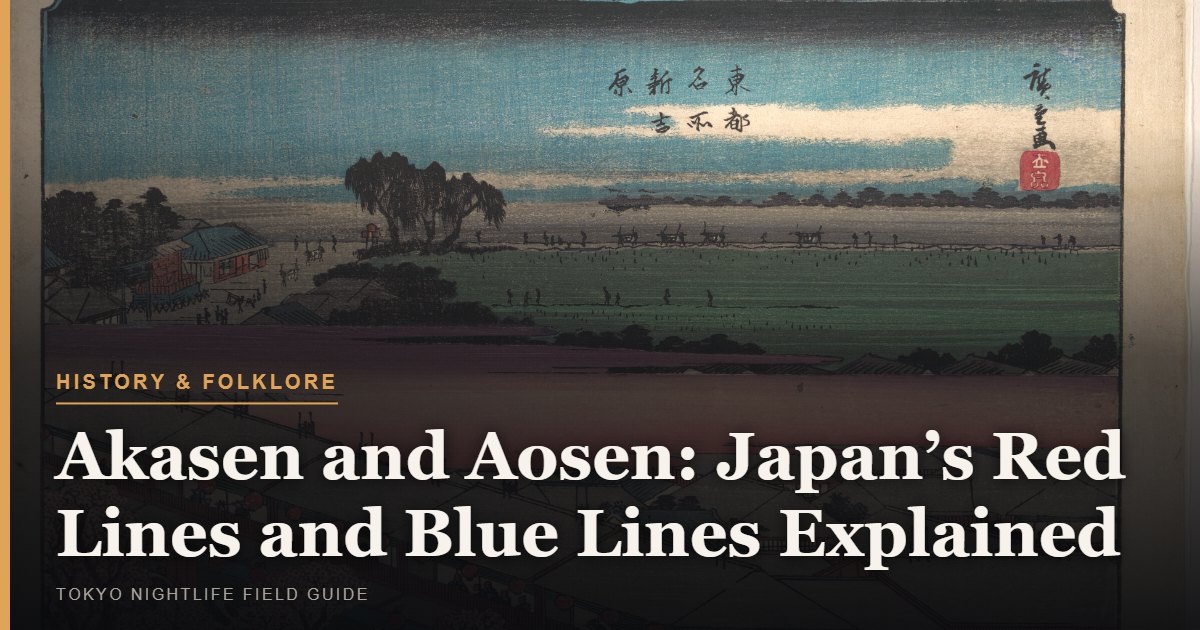
Akasen and Aosen: Japan’s Red Lines and Blue Lines Explained
For about twelve years after the Second World War, Japan had a sex industry that was officially abolished and openly operating at the same time. The occupation had ordered licensed prostitution abolished in January 1946. Yet brothels kept their doors open, kept their addresses, and kept being visited by police who knew exactly what was inside. The way officials squared this circle was bureaucratic and quietly absurd: they drew lines on a map in colored pencil.
Those lines gave Japanese two words that are still in use eighty years later. Akasen (赤線, “red line”) and aosen (青線, “blue line”). If you have read about Yoshiwara, about soaplands, or about why a Japanese adult business will insist it is technically a restaurant, you have run into the consequences of those pencil marks. This is what they actually meant.
Two colors on a policeman’s map
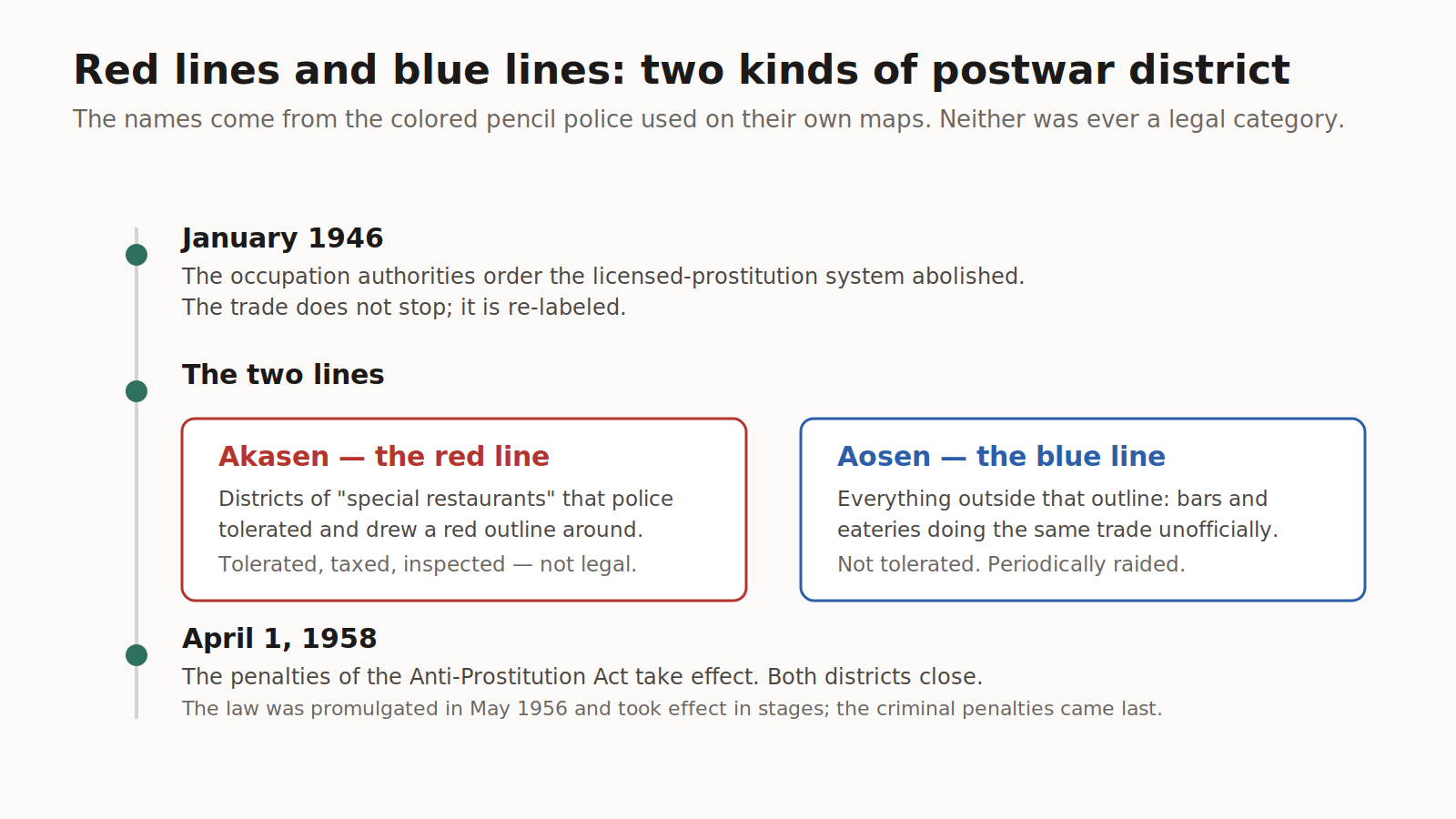
The conventional explanation is straightforward. After licensed prostitution was abolished, police and municipal authorities still needed to keep track of where it was happening. On their internal maps they outlined in red pencil the districts where former brothels had re-registered under a new business category and were being tolerated. Areas where prostitution went on outside that arrangement — without the new license, without the official fiction — came to be called blue-line districts.
So the distinction was never between legal and illegal in the way an English reader might expect. Prostitution itself had no clear criminal penalty attached to it during most of this period: a study of the Home Ministry’s police files shows that official policy did not forbid an individual from engaging in prostitution voluntarily. The red line marked the tolerated, inspected version. The blue line marked everything the authorities knew about but had not brought inside that system.
It is worth saying plainly that the documentary origin of the color convention is not as well established as the confidence of most retellings suggests. The maps were internal administrative documents, not published law, and English-language sources repeat the explanation without citing one. Even the English Wikipedia entry contradicts itself, describing aosen in one sentence as “normal” entertainment districts and in the next as non-permitted sex industry districts. The second reading is the one that matches Japanese usage. A blue-line district was not a place where nothing happened; it was a place where the same thing happened with less paperwork.
Before the lines: Japan’s licensed quarters
Japan had run a state-licensed system for centuries. Walled pleasure quarters — yūkaku — date from the late sixteenth century, and under the Tokugawa shogunate Yoshiwara in Edo became the most famous. The point of the walls was control: confine the trade to a known place and police it.
The Meiji government inherited this and, in 1872, issued the Geishōgi Kaihōrei, an edict emancipating indentured courtesans and performers. It was prompted in part by an international embarrassment — the Maria Luz incident, in which Japan freed Chinese labourers from a Peruvian ship and was promptly asked by the ship captain’s side how a country that indentured its own women could lecture anyone about bondage.
The edict freed the women on paper. It did not close the quarters. Within a short time the same houses were operating under a licensing regime for kashizashiki — “rented rooms” — in which the establishment merely rented space and the women were, legally speaking, independent. This pattern of abolishing the practice while licensing the venue is the single most important thing to understand about Japanese sex-industry law. It recurs in 1946. It recurs after 1958. It is why soaplands exist.
January 1946: the order that abolished licensed prostitution
On January 21, 1946, the Supreme Commander for the Allied Powers issued a memorandum to the Japanese government titled Abolition of Licensed Prostitution in Japan, cataloged as SCAPIN-642. Its language was blunt. Licensed prostitution, it said, “is in contravention of the ideals of democracy and inconsistent with the development of individual freedom.”
It ordered two things. First, that Japan “abrogate and annul all laws, ordinances and other enactments which directly or indirectly authorize or permit the existence of licensed prostitution.” Second, that it “nullify all contracts and agreements which have for their object the binding or committing, directly or indirectly, of any woman to the practice of prostitution.”
The second clause mattered more than the first. The licensing system had always rested on debt. Women entered the quarters under advances paid to their families and worked against a balance that had a habit of never reaching zero. Canceling the contracts was the part that could have ended the system.
The context nobody put in the directive
Five months earlier, in August 1945, the Japanese government had helped establish the Recreation and Amusement Association — a network of facilities set up to serve arriving Allied troops, staffed by women recruited with advertisements that were, to put it generously, imprecise about the work. Occupation authorities declared RAA facilities off-limits to Allied personnel in March 1946, weeks after ordering licensed prostitution abolished.
The “special restaurant” workaround
Abolishing the licensing system removed the legal basis for brothels. It did not remove the brothels, the women who depended on the income, or the demand. What followed was the 1872 pattern again, faster.
Former licensed houses re-registered as tokushu inshokuten (特殊飲食店) — “special restaurants.” On paper they sold food and drink. The women were independent adults who happened to be on the premises. The authorities knew precisely what this was, priced it into their planning, and drew the red line around it.
| Red line (akasen) | Blue line (aosen) | |
|---|---|---|
| Business registration | Registered as a “special restaurant” | Ordinary eating-and-drinking license only |
| Official status | Tolerated and tracked | Known but outside the arrangement |
| Tokyo examples | Yoshiwara, Shinjuku Ni-chōme, Hatonomachi | — |
Neither category was a legal term. You will not find “akasen” in a statute. They were working shorthand that passed into ordinary speech and into film — Kenji Mizoguchi’s final picture, released in 1956, is called Akasen Chitai, “Red-Line District.”
What the red-line districts were actually like
They were neighborhoods, not compounds. The walls were gone. A red-line district was a few blocks of narrow streets, closely built wooden houses with distinctive tiled or glazed façades, and a density of business that made the purpose obvious from the end of the street.
The economics had not improved much since the Meiji period. Advance payments still bound women to houses, notwithstanding the 1946 order nullifying such contracts; police files from 1947 record that such cases were still “often seen.” Recent scholarship on the occupation period — including work presented through Harvard’s Reischauer Institute on women’s welfare cooperatives in Tokyo’s red-light districts between 1946 and 1958 — has examined how women in these districts organized among themselves, which is not how the period is usually told. Academic work on the occupation has also traced how the districts functioned as a form of control over women’s bodies and over urban space.
This is the part that gets flattened in most English retellings. The red-line era is often written as a piece of color — neon, jazz, postwar disorder. For the women inside it, it was a debt structure with an inspection schedule.
1956: the law that took two more years to bite
Pressure to close the system built through the early 1950s, driven substantially by women’s organizations and by the female members who entered the Diet after 1946. The result was the Anti-Prostitution Law (売春防止法), Law No. 118 of 1956.
Here is the detail that almost every English source drops, and it is the one that explains everything about the period. The law was promulgated on May 24, 1956, came into force on April 1, 1957, and its penal provisions did not take effect until April 1, 1958. The Cabinet Office’s Gender Equality Bureau publishes the text with the first two dates on its face; the 1958 date is in the supplementary provisions of the original text of the law.
What the law does and does not prohibit
The Anti-Prostitution Law bans solicitation, procuring, contracting for prostitution, and running a place for it. It does not attach a criminal penalty to the simple act of selling or buying sex between two adults. Article 3 declares that no person may engage in prostitution, but that declaration carries no punishment on its own. The enforceable offenses sit around it, not on it.
That drafting choice is the direct ancestor of the modern Japanese adult industry. Everything that exists today exists in the space the 1956 law left open.
April 1, 1958
On the day the penalties took effect, the red lines ended as a legal arrangement.
| Year | Event |
|---|---|
| 1617 | Yoshiwara licensed in Edo; the walled-quarter model is set |
| 1872 | Geishōgi Kaihōrei emancipates indentured women; houses re-license as “rented rooms” |
| Aug 1945 | Recreation and Amusement Association established |
| 21 Jan 1946 | SCAPIN-642 orders licensed prostitution abolished and binding contracts nullified |
| Nov 1946 | Former brothels re-register as “special restaurants”; the red-line districts take shape |
| Mar 1946 | RAA facilities declared off-limits to Allied personnel |
| May 24, 1956 | Anti-Prostitution Law promulgated (Law No. 118) |
| 1 Apr 1957 | Law comes into force |
| 1 Apr 1958 | Penal provisions take effect; red-line districts close |
| 1984 | “Turkish bath” businesses renamed soapland |
Where the lines went
Yoshiwara converted
Yoshiwara had buildings, land, operators with money, and a name worth keeping. Its houses reopened as bathing establishments, then known by a name borrowed from Turkey, in which a bath attendant washed the customer. The bathing was real. The legal fiction had moved from the dining room to the bathroom, and that was enough. Those businesses were renamed soapland in 1984, after a Turkish student in Japan objected to the original term.
Osaka kept one running in plain sight
Tobita Shinchi in Osaka reopened as ryōtei — traditional restaurants. It is the 1872 pattern and the 1946 pattern, performed a third time, and it is still being performed.
How to read a former red-line street
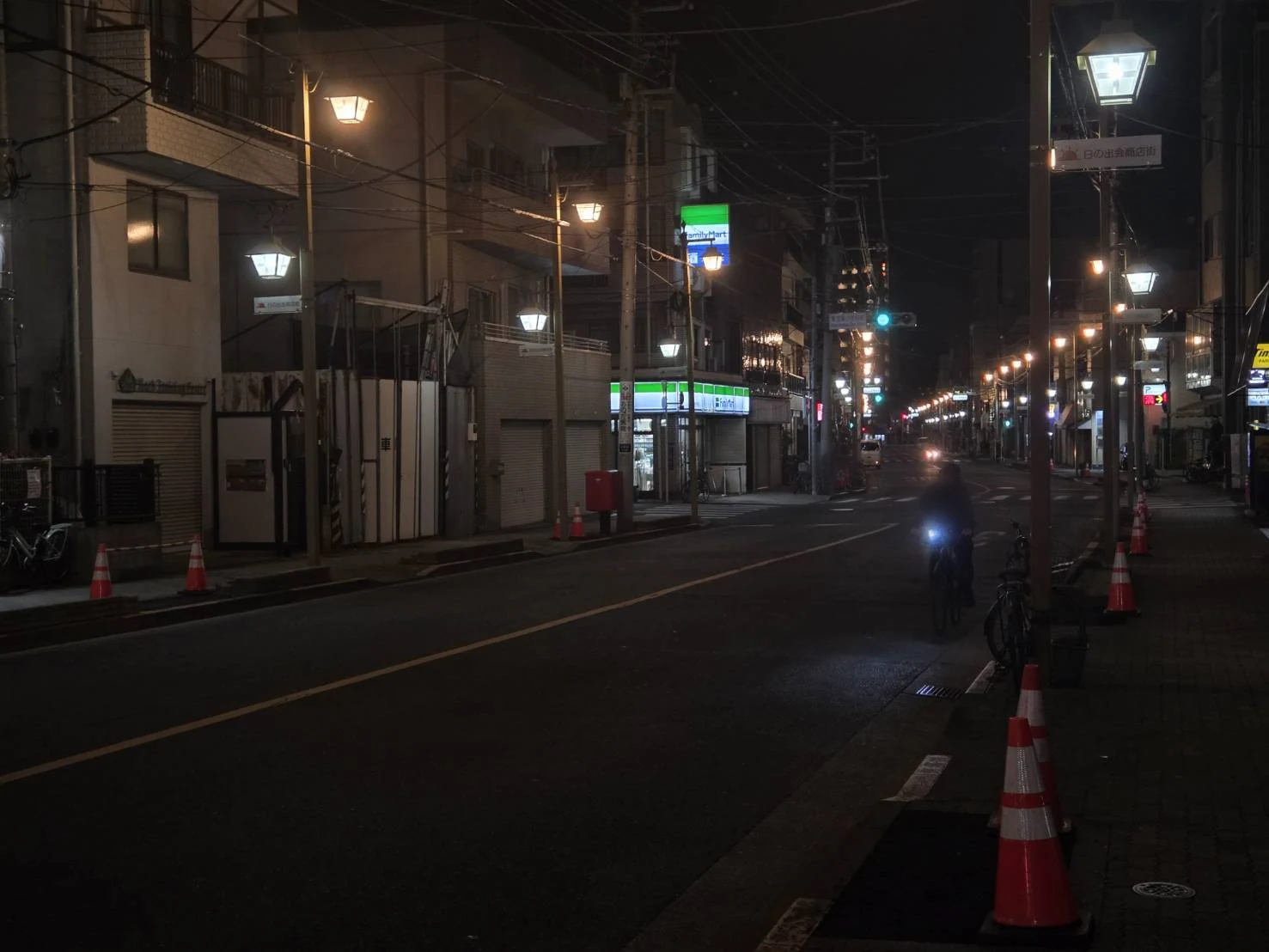
If you walk into one of these districts without knowing what you are looking at, it reads as an unremarkable older neighborhood. A few things give it away.
The street pattern is wrong
Former quarters were built to be entered at one point and walked through. Lanes are noticeably narrower than the surrounding grid and often do not connect cleanly to it, because they were laid out inside a boundary that no longer exists.
The façades do not match the houses
Buildings from the period carry decoration that ordinary housing of the same date does not: glazed tile in green or ochre, curved bay windows, tiled entrance floors, small decorative balconies. The money went into the first three meters of the front elevation and nowhere else. In Tobita Shinchi this is still the most visible thing about the street.
Boundary markers survive as landmarks
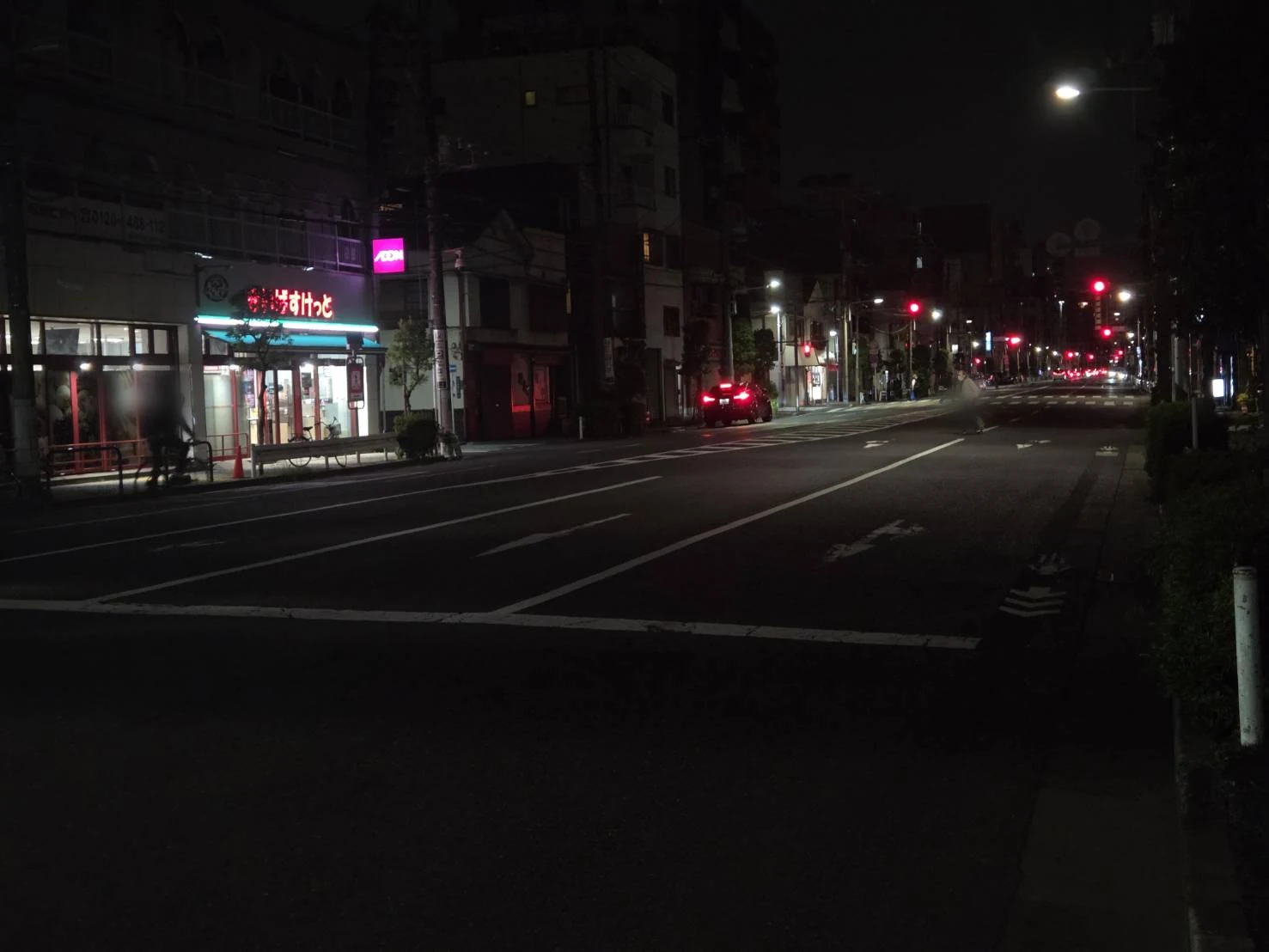
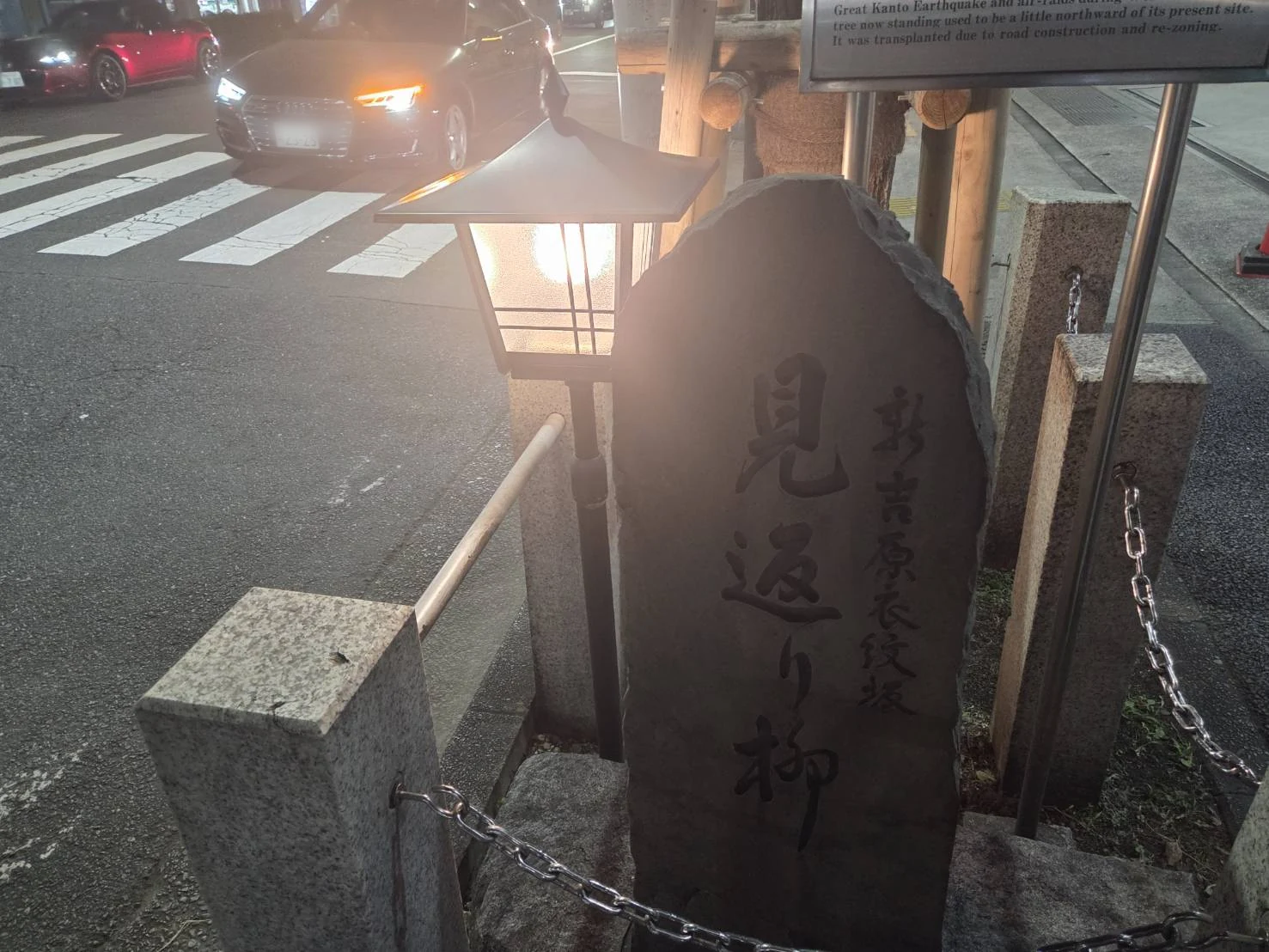
Where a quarter had a gate, the gate is usually gone and the intersection retains the name. Yoshiwara’s Ōmon — the great gate — exists now as an intersection called Yoshiwara Ōmon. The Mikaeri-yanagi, the “looking-back willow” where departing customers turned for a last glance, has been replanted several times and stands with a marker.
None of this requires a guide, and none of it is signposted as history. Japan does not commemorate these districts. What is left is in the paving and the tilework.
Why the words still matter
Japanese still uses both terms, in two ways.
Historically, to date a building or a neighborhood: akasen no nagori, “traces of the red line,” is what an architecture enthusiast says about a particular kind of tiled façade in Yoshiwara or Tobita. Loosely, to describe any area with a visible sex industry, which is imprecise but common.
The more important legacy is structural. Every legal Japanese adult business today is registered as something else — a bathhouse, a massage business, a delivery service, an entertainment venue. That is not evasion invented recently. It is an administrative habit established in 1872, formalised in 1946, and given its permanent shape by the two years between the 1956 law’s promulgation and its penalties. The red pencil is gone. The thinking that drew it is not.
Frequently asked questions
What is the difference between akasen and aosen?
Both refer to districts where prostitution took place between 1946 and 1958. Akasen districts were tolerated under an official workaround: former brothels re-registered as “special restaurants” and were tracked and health-inspected. Aosen districts operated outside that arrangement, usually under an ordinary food-and-drink license. The origin of the color names is not firmly documented.
Was prostitution legal in Japan’s red-line districts?
Licensed prostitution was ordered abolished in January 1946, so the districts had no legal basis as licensed quarters. But selling sex between adults carried no criminal penalty of its own, then or after 1958, and the districts were tolerated until the Anti-Prostitution Law’s penalties on procuring and running a house took effect on April 1, 1958.
When did the red-line districts close?
April 1, 1958, when the penal provisions of the 1956 Anti-Prostitution Law came into effect. The law had been promulgated on May 24, 1956 and in force since April 1, 1957, but its penalties applied only from April 1, 1958, which is why the districts kept operating until then.
Can you still visit the old red-line districts?
They are ordinary neighborhoods and you can walk through them. Yoshiwara in Tokyo and Tobita Shinchi in Osaka retain both their street layouts and a concentration of adult businesses. Tobita Shinchi does not permit photography.
Why is Yoshiwara still associated with the sex industry?
Because it converted rather than closed. When the red lines ended in 1958, Yoshiwara’s operators had the capital and the property to re-open as bathing establishments — later renamed soaplands — under a different license.