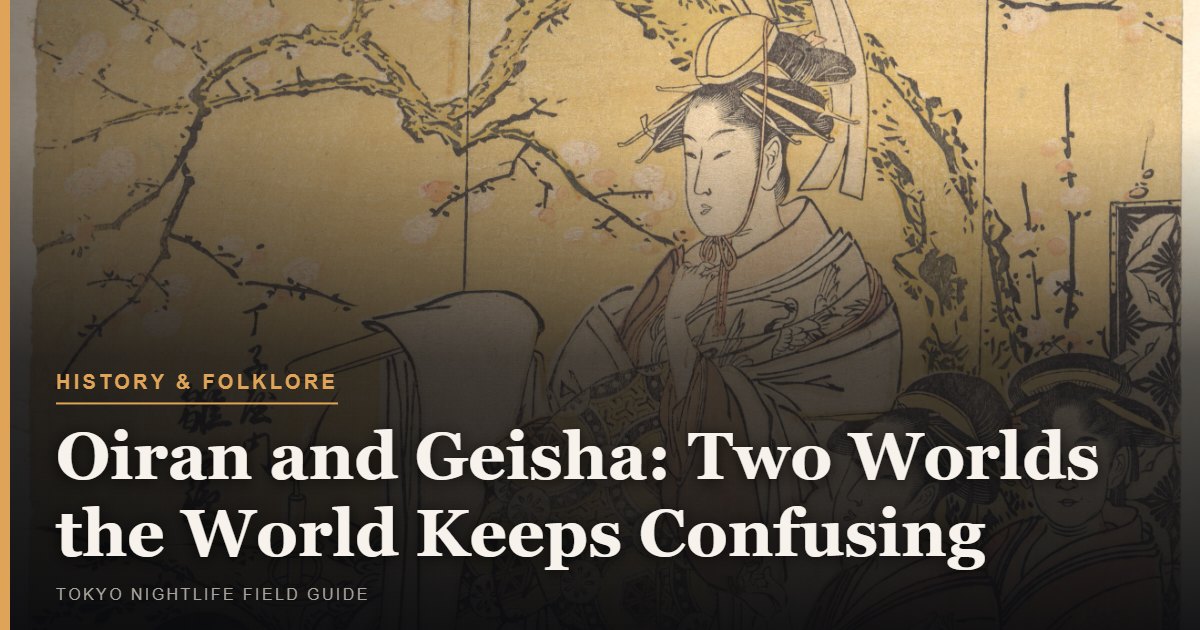
Oiran and Geisha: Two Worlds the World Keeps Confusing
An oiran was a ranked courtesan who lived and worked inside a licensed pleasure quarter such as Edo’s Yoshiwara. A geisha was, and still is, a professional entertainer trained in music, dance, and conversation, registered in a separate geisha district called a hanamachi. The two shared a city, a clothing culture, and sometimes a street, but they belonged to different legal categories, answered to different employers, and were paid for different things. Sex was the business of the licensed quarter; performance was the business of the geisha.
The confusion is mostly foreign-made: occupation-era “geisha girls,” a best-selling American novel, and the fact that both women wore silk kimono. This guide separates the two with primary sources: the 1872 edict, the 1956 Anti-Prostitution Act, museum records, and the hanamachi associations’ own materials. Where a popular claim could not be traced to a primary source, we say so.
The Short Answer: A Performing Artist vs. a Licensed Courtesan
If you only remember one thing, remember where each woman was registered. In the Edo period, the shogunate licensed specific walled quarters for prostitution. Yoshiwara, licensed in 1617 and opened in 1618, was the only officially licensed pleasure quarter in Edo, according to a study of its customer regulations by historian Takagi Madoka published through Seijo University. The women who worked there as yūjo (courtesans) were bound to a brothel house, and the highest-ranked of them came to be called oiran.
Geisha grew up alongside this system but were deliberately kept apart from it. Their job was the gei in their name, which means “art”: shamisen, song, dance, and the skill of running a banquet. Today the Kyoto foundation that represents the city’s five geisha districts describes its mission as preserving the districts and passing on their traditional performing arts, not as anything to do with the old licensed quarters.
For the walled quarter itself, see our guide to three centuries of Yoshiwara.
What a Geisha Was — and Still Is
A geisha is a woman (historically also some men, known as hōkan) employed to entertain guests with performance and conversation at private banquets. In Kyoto the word used is geiko, and an apprentice is a maiko. The profession is organized by district, and each district is a hanamachi, literally a “flower town.”
Where geisha work: hanamachi, okiya, ochaya, and the kenban
Three institutions hold a hanamachi together. The okiya is the house that recruits, trains, and houses geisha; the Kyoto foundation notes that maiko live in at an okiya during their apprenticeship. The ochaya (teahouse) or ryōtei (traditional restaurant) is where the banquet happens. The kenban is the registry office that keeps track of which geisha are working, and handles bookings.
The word began, per the Tokyo Kagai Information site, as a “viewing board” listing available geisha. In Asakusa the kenban is still the public face of the district: the Asakusa Kenban represents both geisha and hōkan and stages the Asakusa Odori, a dance program the association dates to 1950, when it began under the name Asaji-kai.
How geisha are paid
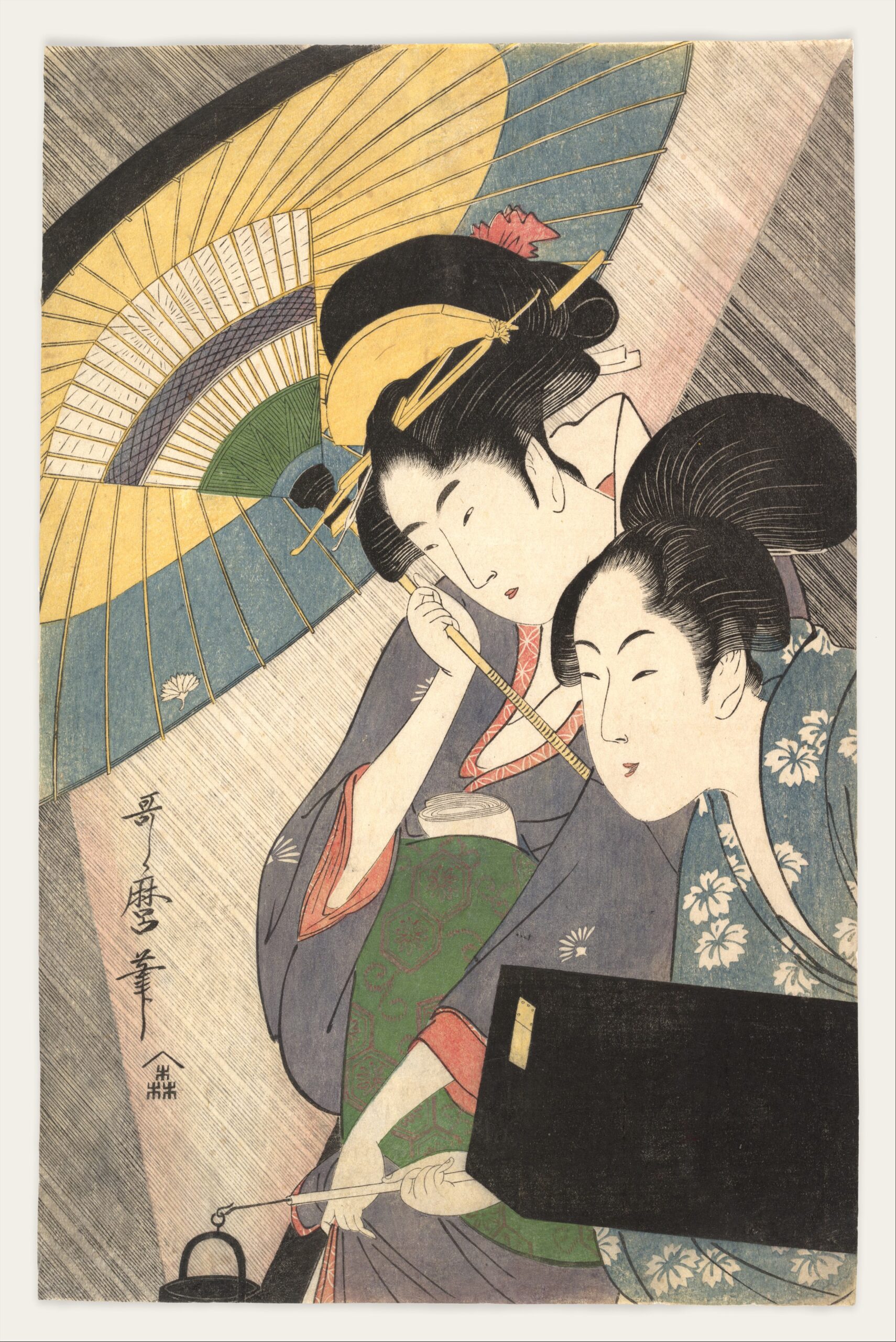
Geisha are paid for time at a banquet, billed through the teahouse or restaurant and settled with the okiya and kenban. The performance and the hosting are the product. In the Met’s print of about 1797 by Kitagawa Utamaro, a geisha walks through the rain at night with a maid carrying her shamisen case. The instrument, not the kimono, marks her trade.
What an Oiran Was
An oiran was a high-ranking courtesan of Yoshiwara. The word belongs to Edo specifically, and it came into use fairly late. The late-Edo writer Kitagawa Morisada recorded in his Morisada Mankō that Edo “formerly called them tayū; now they write 花魁 and read it oiran.” A popular etymology traces the word to juniors calling their senior “oira no tokoro no neesan” (“our house’s big sister”); we could not confirm it.
Life inside a licensed quarter
An oiran was not a freelancer. She was contracted to a brothel house and worked off her debt over a term of years. She could not leave the quarter freely. Her clients paid the house, and the costs of living in the house added to what she owed. Our companion piece on the walled quarter covers the gate, the moat, and the rules that kept women in.
Prices depended on rank. According to nippon.com’s article on Morisada’s record, an evening with the top class of his day, the chūsan (whose highest grade was called yobidashi), required at least one ryō and one bu, which the article estimates at roughly ¥130,000 in modern terms.
Ranks: from tayū to oiran
Courtesan ranks changed over the Edo period, and English sources often flatten them into a single ladder. What Morisada’s record shows is a shift in vocabulary: the Kyoto and Osaka quarters kept the title tayū, while Edo’s top women were called oiran. Below them were shinzō (teenage courtesans in training or in early service) and kamuro (child attendants). The Metropolitan Museum’s 1796 work by Unchō shows exactly this group: “a high-ranking courtesan (oiran), accompanied by her teenage apprentice (shinzō) and two child attendants (kamuro)” walking under a willow.
The image most people have of an oiran is the oiran dōchū, the slow parade from the brothel house to the teahouse where a client waited. It was advertising as much as ritual, and it is the only form in which “oiran” survives today.
How to Tell an Oiran from a Geisha on Sight
Edo artists and their buyers could tell the two apart at a glance, because the clothing rules were designed to make that possible. The Tokyo Kagai Information site, a long-running reference on Tokyo’s geisha districts, notes that as geisha were separated from courtesans, dress codes followed: geisha tied the obi at the back, courtesans at the front. The table below sets out the main markers. Items marked “prints” come from how period art and today’s re-enactments show them rather than from a written rule we could check.
| Marker | Oiran (Edo courtesan) | Geisha / maiko |
|---|---|---|
| Obi knot | Tied in front, often wide and hanging | Tied at the back; a maiko’s long dangling darari obi also hangs at the back |
| Hair ornaments (prints) | A dense halo of long hairpins and large combs | Fewer, smaller pins; a maiko’s seasonal flower kanzashi |
| Footwear (prints) | Very tall black lacquered clogs for the parade | Ordinary geta or zōri; maiko wear raised okobo |
| What travels with her | Child attendants (kamuro) and a teenage shinzō | A shamisen case, often carried by an attendant |
| Employer | A brothel house inside the licensed quarter | An okiya, registered with a district kenban |
| Residence | Inside the walled quarter; could not leave freely | In the okiya during apprenticeship |
| What the client paid for | Access to the courtesan, with rank setting the price | Time at a banquet: performance and hosting |
| Where she exists today | Only as a costumed parade role | A working profession in Kyoto, Tokyo, and other cities |
The front-tied obi is the clearest sign, and the one costume designers most often get wrong: a front knot in a “geisha” photo shoot is, historically, a courtesan’s knot. Popular sources often say the front knot was practical because it could be retied without help; we found no period source for that, so treat it as a guess. The ornaments tell the same story. Formal oiran dress displayed the house’s wealth and the woman’s rank, while a geisha’s look was meant to be refined, because her selling point was skill.
Training and Ranking Paths
Both professions took in girls young and both involved debt to a house, but the training led to different places.
Geisha: shikomi, minarai, maiko, geiko
The Kyoto foundation’s own description of the path is precise. Recruits today must have finished junior high school; the foundation notes that starting at 10 or 13 was once not unusual. A trainee then spends about one year in shikomi, helping in the okiya while learning etiquette, the district’s Kyoto speech, and dance. That is followed by about one month of minarai, attending banquets alongside a senior geisha, before her debut as a maiko. After several years as a maiko she changes her collar from red to white, a step called erikae, and becomes a full geiko.
Advancement rests on skill and seniority, shown on public stages such as Gion Kobu’s Miyako Odori, which the foundation dates to 1872.
Oiran: kamuro, shinzō, oiran
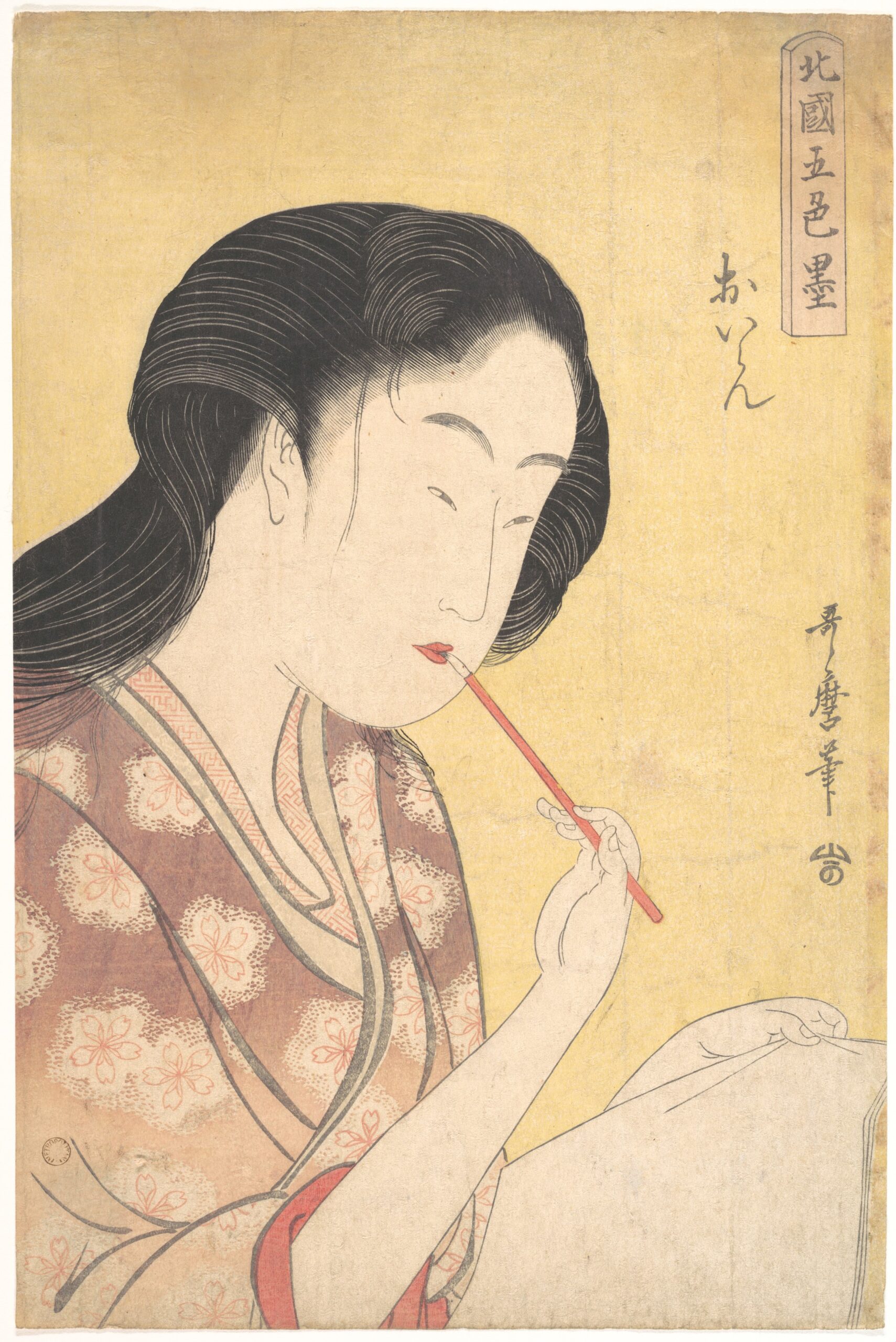
A girl sold into a Yoshiwara house as a child could serve first as a kamuro, running errands for a senior courtesan and learning manners and some arts. As a teenager she became a shinzō, and a promising shinzō could be groomed as an oiran. The Met’s Utamaro print shows an oiran preparing to write a letter. But the endpoint was sex work under contract, and her rank decided her price, not her mastery of an art. The Tokyo Metropolitan Archives describe the women as bound by debt, which is why the 1872 edict had to state that they owed nothing.
How the Law Separated Them: 1618 to 1958
The clearest proof that these were two worlds is legal.
| Year | Event | What it meant for oiran and geisha |
|---|---|---|
| 1618 | Yoshiwara established as Edo’s only licensed pleasure quarter | Courtesans confined to a single licensed district |
| Late 1700s | A kenban set up inside Yoshiwara (commonly dated to 1779; not verified here) | Geisha registered separately, to keep their work apart from the courtesans’ |
| 1872 | Dajōkan Proclamation No. 295 (“liberation of geisha and prostitutes”) | Human trafficking banned; debts of both geisha and courtesans declared unenforceable |
| After 1872 | The “rented room” (kashizashiki) system | Licensed prostitution rebuilt with women recast as self-employed |
| 1872 | First Miyako Odori in Gion Kobu | Geisha arts presented as public culture |
| 1946 | Occupation directive abolishing licensed prostitution | Brothels carry on as “special restaurants” in red-line districts |
| 1956 | Anti-Prostitution Act (Act No. 118), promulgated May 24 | Prostitution defined and prohibited |
| 1958 | The Act’s penalties take effect on April 1 | The licensed-quarter world ends; geisha districts continue |
The National Diet Library’s legal index lists the order as Dajōkan Proclamation No. 295 of Meiji 5 (1872), whose full title bans human trafficking, limits terms of service, “releases geisha and prostitutes,” and refuses to hear lawsuits over their loans. Note the wording: geisha and prostitutes, two categories, named side by side precisely because they were different. The Tokyo Metropolitan Archives add that the order came as a set with Ministry of Justice Notice No. 22, and that licensed prostitution was quickly rebuilt. Brothels became “rented room” businesses, and the women were recast as working of their own free will.
The Anti-Prostitution Act, Act No. 118 of May 24, 1956, defines prostitution in Article 2 as sex with an unspecified partner in exchange for payment or its promise, and Article 3 states that no one may engage in it. The general provisions took effect on April 1, 1957, and the penalties on April 1, 1958. The postwar red-line districts that had replaced the licensed quarters closed; our pieces on the red and blue lines and on the year they closed tell that story. Geisha districts had no such ending. They were not built on the thing the Act banned.
Why the Confusion Took Hold in English
Occupation-era “geisha girls”
After 1945, some women selling sex to Allied soldiers advertised themselves to foreigners as “geisha girls.” The English Wikipedia article on geisha describes prostitutes “almost exclusively working for the occupying forces” using the label, and GIs repeating it. The label was a translation shortcut. Most soldiers had no way to know that the women they met in bars and state-organized facilities had no connection to a hanamachi. Our article on the RAA’s official postwar comfort facilities shows how that system was set up and why “geisha” was the wrong word for it. Nothing in the later neon districts, including the postwar story of how Kabukicho was built, comes out of the geisha lineage either.
A novel, a film, and a lawsuit
The second driver was Arthur Golden’s best-selling novel Memoirs of a Geisha and its Hollywood film. The plot turns on the heroine’s virginity being sold to the highest bidder in a ceremony called mizuage. Golden had interviewed the retired Gion geiko Iwasaki Mineko. She then sued him in 2001 for breach of contract and defamation. The case was settled out of court in 2003. Iwasaki said the book gave a false picture of her world, and in 2002 she published her own account, Geisha: A Life (titled Geisha of Gion in the UK).
Same silk, different worlds
The third reason is visual. Both women wore silk kimono and ornamented hair, and ukiyo-e prints of both were sold side by side. Kept apart by law and geography, they still looked alike to outsiders, and that was enough for the labels to merge.
The Mizuage Claim: What Is Documented and What Is Repeated
“Mizuage” is where most English articles go wrong, in both directions. Some present it as a universal geisha rite; others deny it ever touched geisha at all. The evidence supports neither extreme.
What is documented. The word was used in the licensed quarters for a courtesan’s first client, whose access the house sold. It was also used in some geisha districts before 1958. Former geisha Masuda Sayo’s 1957 memoir describes being sold for mizuage by her okiya, which she presents as exploitation; the English Wikipedia summary of the mizuage literature lists her account alongside anthropologist Liza Dalby’s. Dalby, who spent a year in Kyoto’s Pontochō under the geisha name Ichigiku and published Geisha with the University of California Press in 1983, is cited there as saying older geisha remembered it as unpleasant but a stage of growing up.
What is contested. Iwasaki said the custom as the novel depicts it did not exist in Gion and that she never underwent it; in her telling, the word marked a maiko’s graduation with a round of formal visits, not a sale. Both accounts can be true at once: practice varied by district, by decade, and by okiya.
What is only repeated. We could not find a primary source for the frequent claims that mizuage was a standard, district-wide auction, that it applied to every maiko, or that specific prices were paid. Those details trace back to the novel and to secondary retellings. After the 1956 Act took full effect in 1958, any sale of a first encounter fell under Article 3’s ban on prostitution regardless of name. Today maiko move up through erikae, a collar change with formal visits, with no sexual component.
Were Geisha Prostitutes? A Direct Answer
No, geisha were not prostitutes by profession, and they are not today. The legal record separated them from courtesans in 1872, naming the two groups side by side. The licensed quarters ended when the 1956 Act’s penalties took effect in 1958, while the geisha districts carried on because their business, performance at banquets, was never the thing the law banned.
The honest qualification is that the line was not always clean in practice. Before 1958, some geisha were pushed into sex work by debt, and some women used the title as a cover. The Tokyo Kagai Information site records that, during one Edo-period crackdown, 115 dancers in Fukagawa who also sold sex were arrested and sent to Yoshiwara. Arrests like that show the authorities policing the boundary, and they also show that it was sometimes crossed. What was never true is that sex was the product a geisha district sold. That was the business of the licensed quarter.
What Survives Today
Working geisha: the numbers we can source
There is no official national census of geisha, and no ministry publishes one. The figures in circulation come from scholars and private tallies, and most are old:
- Dalby’s research, as cited in the English Wikipedia article on geisha, puts the prewar peak at about 80,000 geisha nationwide. The same article cites a New York Times estimate of 600–700 by 1989.
- The Tokyo Kagai Information site counted about 274 geisha across Tokyo in 2015, with Mukōjima (about 90) and Shinbashi (about 60) the largest districts. For Kyoto the same page gives 273 geiko and maiko in 2007.
Treat these as approximate and dated; we found no current published count from the Kyoto foundation or the Tokyo associations. What is certain is that the profession is small, organized, and working: Kyoto’s five districts (Gion Kobu, Miyagawachō, Pontochō, Kamishichiken, and Gion Higashi) still hold public dance programs every year, and Tokyo’s districts, including Asakusa, Shinbashi, Akasaka, and Mukōjima, still take banquet bookings through their kenban.
Oiran today: a costume, not a profession
No one works as an oiran today. The profession ended with the licensed quarters, and in law with the 1956 Act. What you can see is the oiran dōchū re-enactment: a costumed parade staged at festivals and events by performers and volunteers, with no connection to sex work. An “oiran experience” at a photo studio is a costume session. The Yoshiwara area itself later took a very different path, which our history of the “Turkish bath” to soapland renaming explains.
If you visit, remember that the hanamachi are neighborhoods where people live. Keep to public streets, do not follow or photograph maiko and geiko at close range, and see the arts the way the associations offer them: at the public dance programs and events like the Asakusa Kenban’s open performances.
Frequently Asked Questions
What is the main difference between an oiran and a geisha?
An oiran was a high-ranking courtesan contracted to a brothel house in a licensed quarter. A geisha is an entertainer paid for music, dance, and hosting, registered with a district kenban.
Were geisha prostitutes?
No. Sex was never the product of the geisha districts, which continued after the 1956 Anti-Prostitution Act closed the licensed-quarter world. Before 1958 the boundary was sometimes crossed under debt pressure.
Do oiran still exist?
Not as a profession. Oiran appear only as costumed performers in festival re-enactments of the oiran dōchū procession.
How can you tell an oiran from a geisha in a picture?
Check the obi: a front knot marks a courtesan, a back knot a geisha. In prints, oiran also wear far more hairpins, while geisha are often shown with a shamisen case.
Is Memoirs of a Geisha accurate?
It is a novel. Iwasaki Mineko, the retired geiko it drew on, sued the author in 2001; the case settled in 2003.
How many geisha are there today?
There is no official count. The latest figures we could verify are about 274 in Tokyo (2015) and 273 in Kyoto (2007), both approximate.