1958: The Year Japan Closed the Red Lines
On April 1, 1958, the penal chapter of Japan’s Anti-Prostitution Act (売春防止法, Law No. 118 of 1956) took effect, and the tolerated “red-line” districts that had operated since the late 1940s lost their legal footing overnight. The short answer to “what happened in 1958” is this: Japan did not make selling sex a crime. It made soliciting, procuring, and running the business crimes, and it built a network of state counseling offices and shelters for women at the same time. The act of prostitution itself was declared illegal but carries no penalty to this day. That gap is why the trade did not vanish in 1958. It changed form, moved into other premises, and was later channeled into the bathhouse category that Japan’s entertainment-business law regulates today.
This article follows the law from the Diet floor to the morning after, using the statute text on e-Gov, the National Diet Library’s law index, and the Diet’s own minutes. Where a popular claim could not be checked against a primary source, we say so.
Where the Red-Line Story Left Off
Our earlier piece on how the red lines and blue lines came to exist covered 1946 to 1956. In brief: the January 1946 occupation directive SCAPIN-642 ended Japan’s system of licensed prostitution, but operators kept working under the label of “special restaurants” (特殊飲食店). Police marked the tolerated zones on maps with red lines. “Blue lines” were areas where bars ran as ordinary food businesses and were quietly tolerated. The arrangement was never written into a statute. The older background, including the walled quarter that came before all of this, is in our history of Yoshiwara’s three centuries, and the occupation-era facilities that the state itself set up in 1945 are covered in our article on the RAA comfort stations.
Years of Failed Bills Before One Passed
The 1956 act was not the first attempt. A Ministry of Justice briefing paper prepared for a government study group lists the history plainly: a Prostitution Punishment Bill (売春等処罰法案) was submitted in 1948 and failed; further versions were submitted several times between 1953 and 1955, and all of them failed. Every one of those bills, the ministry notes, included penalties for the act of prostitution itself. The bill that finally passed in 1956 did not.
The women who wrote the bill
The Diet minutes show who carried the effort. On July 21, 1955, the chair of the House of Representatives Judicial Affairs Committee, Seko Koichi, reported to the full House that the Prostitution Punishment Bill had been submitted by 19 women members of the House with 88 co-sponsors. The bill’s purpose had been explained to the committee by one of its sponsors, the Socialist member Kamichika Ichiko (神近市子), who spoke for the bill on the floor that day, as did the Socialist member Yamaguchi Shizue. The committee had already voted it down.
The floor vote was taken by named ballot. According to the minutes, 333 votes were cast: 191 in favor of upholding the committee’s rejection and 142 against. The bill died.
The pressure from the upper house
Within a week, in the upper house Judicial Affairs Committee on July 27 and 28, 1955, members Miyagi Tamayo, Akamatsu Tsuneko, and Ichikawa Fusae pressed the government to bring its own bill. Miyagi raised suspicions that operators had given money to legislators, and Ichikawa asked about the operators’ organized campaign to block the bill. These are questions in the minutes, not findings. By December 1955, Miyagi was welcoming the creation of a government council on prostitution policy and asking when a bill would arrive.
A common explanation for the turnaround is that the governing Liberal Democratic Party, formed in November 1955, changed its position to win women’s votes ahead of the 1956 upper-house election. That account is widely repeated in secondary sources, but we could not confirm the motive from the Diet record we read, so treat it as an interpretation rather than a documented fact.
The 1956 Act and Its Two-Stage Clock
The version that passed was a cabinet bill, not a members’ bill. The National Diet Library’s Japanese law index records the steps: submitted to the House of Representatives on May 2, 1956, passed there on May 15, passed by the House of Councillors on May 21, and promulgated on May 24, 1956 as Law No. 118, during the 24th Diet session.
The date that matters most is hidden in the supplementary provisions (附則). The original text, preserved on the House of Representatives website and still shown on e-Gov, reads (our translation): “This law shall come into force on April 1, 1957. However, the provisions of Chapter 2 and paragraph 2 of the supplementary provisions shall come into force on April 1, 1958.” Chapter 2 is the criminal chapter. Paragraph 2 repealed the 1947 Imperial Ordinance No. 9, the occupation-era order that punished people who made women sell sex.
So the law ran on a two-stage clock. From April 1957, the purpose clause, the prohibition in Article 3, and the protection system were in force. The penalties waited another year. Even some official reference copies flatten this: a Cabinet Office Gender Equality Bureau handout of the statute gives only “promulgated May 24, 1956; in force April 1, 1957” in its header. Both dates are right. They describe different parts of the law.
| Date | Event | Source |
|---|---|---|
| 1948 | First Prostitution Punishment Bill submitted; not passed | Ministry of Justice briefing paper |
| 1953–1955 | Several further bills submitted; all fail | Ministry of Justice briefing paper |
| July 21, 1955 | Bill by 19 women members rejected in the House of Representatives, 191 to 142 on a named ballot | Diet minutes |
| May 2–21, 1956 | Cabinet bill submitted and passed by both houses | NDL Japanese law index |
| May 24, 1956 | Promulgated as Law No. 118 of 1956 | NDL Japanese law index |
| April 1, 1957 | Main provisions in force: purpose, Article 3 prohibition, counseling offices and shelters | Supplementary provisions |
| March 25, 1958 | First amendment (Law No. 16 of 1958) adds “guidance disposition” (補導処分) | NDL index; Ministry of Justice |
| April 1, 1958 | Chapter 2 penalties in force; 1947 Imperial Ordinance No. 9 repealed | Supplementary provisions |
| July 1, 1966 | Entertainment law amendment defines the “bathhouse with private rooms” business | Law No. 91 of 1966 |
| August 14, 1984 | Entertainment law renamed and rebuilt (Law No. 76 of 1984) | NDL index; original text |
| April 1, 2024 | Protection chapter moved to a new women’s support law | Law No. 52 of 2022; Cabinet Office |
What Actually Changed on April 1, 1958
Popular histories describe the last night of March 1958 as a night of closing parties and farewell songs in the red-line districts. The specific scenes that circulate online, including which song was played where, are hard to trace to a primary record, and we have not verified them. What the legal record shows is more useful. Because the main provisions started in April 1957, the red-line operators had twelve months of notice in which the business was declared illegal but not yet punishable. Japanese Wikipedia’s article on the red lines states that the cafés inside the districts had shut down by March 1958, a claim consistent with the one-year grace period but drawn from a secondary source.
A second law, passed a week before
On March 25, 1958, one week before the penalties began, the first amendment to the act was promulgated (Law No. 16 of 1958). According to the Ministry of Justice, it introduced “guidance disposition” (補導処分): a woman convicted of public solicitation under Article 5 could, instead of serving a sentence, be committed to a state women’s guidance home. The Ministry’s own summary notes that this did not require her consent. It was the most coercive part of the new system, and it lasted until the 2022 reform described below.
How many women and businesses were affected
A figure you will see repeated is that about 39,000 premises and about 120,000 women were working in the red-line districts when the penalties arrived. Japanese Wikipedia gives these numbers, and English-language sites repeat them. We could not trace them to a government survey that we were able to open, so we present them as a widely cited estimate, not an official count.
The Ministry of Justice’s 1976 White Paper on Crime gives a firmer picture of enforcement afterward. It reports that the number of people referred to prosecutors under the act fell sharply after the first years, and that in 1959, the first full year of enforcement, violations of Article 5 (public solicitation) made up 72.2% of the total. By 1975 that share had fallen to 52.8%. In other words, the law’s early enforcement landed most heavily on public solicitation, the one act by the seller that the law does punish.
What the Law Bans, and What It Does Not
This is the part many English-language summaries get wrong. Japan’s law has no penalty for selling sex and no penalty for buying it. It punishes the conduct around the act.
Article 3: a ban with no punishment
Article 2 defines prostitution as sexual intercourse with an unspecified partner for payment or a promise of payment. Article 3 then says (our translation): “No person may engage in prostitution or be the other party to it.” There is no penalty clause attached to Article 3, in 1956 or in the current text on e-Gov. Because the law turns on “intercourse,” acts that stop short of it fall outside the definition, which later became the legal basis for much of Japan’s regulated adult-entertainment industry.
Solicitation, procuring, and contracts
Chapter 2 is where the penalties are. Article 5 punishes soliciting in public places for the purpose of prostitution. The original 1956 penalty was up to six months or a fine of up to ¥10,000. Today’s e-Gov text reads up to six months of custodial sentence (拘禁刑, the unified prison term from Japan’s recent penal reform) or a fine of up to ¥20,000. Article 6 punishes arranging prostitution for someone else, with up to two years or a fine of up to ¥50,000. Article 10 punishes making a contract to have a person engage in prostitution.
Premises and management
The heaviest penalties are aimed at operators. Article 11 punishes knowingly providing a place for prostitution, with up to three years or a fine of up to ¥100,000, rising to seven years and ¥300,000 when it is done as a business. Article 12 punishes anyone who has a person live in premises they control or direct and makes that person engage in prostitution as a business. The penalty, unchanged in size since 1956, is up to ten years and a fine of up to ¥300,000, both imposed together. Article 12 describes exactly how a red-line house worked. That is why the districts could not survive April 1958 in their old form.
| Conduct | Status under the Anti-Prostitution Act | Article |
|---|---|---|
| Selling sex (intercourse for payment) | Prohibited, no penalty | Art. 3 |
| Buying sex | Prohibited, no penalty | Art. 3 |
| Soliciting in a public place | Punished: up to 6 months or ¥20,000 fine (¥10,000 in 1956) | Art. 5 |
| Arranging prostitution for others | Punished: up to 2 years or ¥50,000 fine | Art. 6 |
| Contract to make a person engage in prostitution | Punished: up to 3 years or ¥100,000 fine | Art. 10 |
| Providing a place for prostitution | Punished: up to 3 years or ¥100,000 fine; up to 7 years and ¥300,000 fine as a business | Art. 11 |
| Running a house where people are made to engage in prostitution | Punished: up to 10 years and ¥300,000 fine | Art. 12 |
| Sexual services that are not “intercourse” | Outside the act’s definition; regulated separately under the entertainment-business law | Art. 2 |
Where the Women Went: Counseling Offices and Shelters
The 1956 law was not only a criminal statute. A 2018 Ministry of Health, Labour and Welfare study-group paper reproduces its full text. Its original third chapter, titled “Protection and Rehabilitation” (保護更生), ordered every prefecture to act. Under the original Article 16, “prefectures shall establish women’s counseling offices” (婦人相談所). These offices handled consultations, investigations, and temporary protection. Under the original Article 18, prefectures could establish women’s protection facilities (婦人保護施設) to house women in need of protection.
In our reading, that makes 1956 a welfare law as much as a criminal one. For almost seventy years, these offices and shelters were also where many women with other problems ended up. The Cabinet Office now describes the problems women bring to these services as complex and overlapping, from abuse to poverty.
Protection or control?
The protective language sat next to the coercive guidance homes added in March 1958. Xiaofei Guo of the University of Cambridge, writing in a 2025 peer-reviewed article, argues that the law’s stated aim of protecting women coexisted with “new forms of marginalization,” and that what had been “licensed and taxed became criminalized.” In practice, as the 1959 figures show, public solicitation was the offense most often referred to prosecutors.
Where the Businesses Went
The operators did not all disappear. Japanese Wikipedia’s summary of the red-line districts lists the common paths: conversion to bars and snack bars, restaurants, “Turkish baths,” inns and later love hotels, public bathhouses, apartments, and lodging houses. That list is a secondary summary, and the proportions are not documented in any primary source we could open. The pattern, however, is visible on the ground.
Conversion into bars, inns, and housing
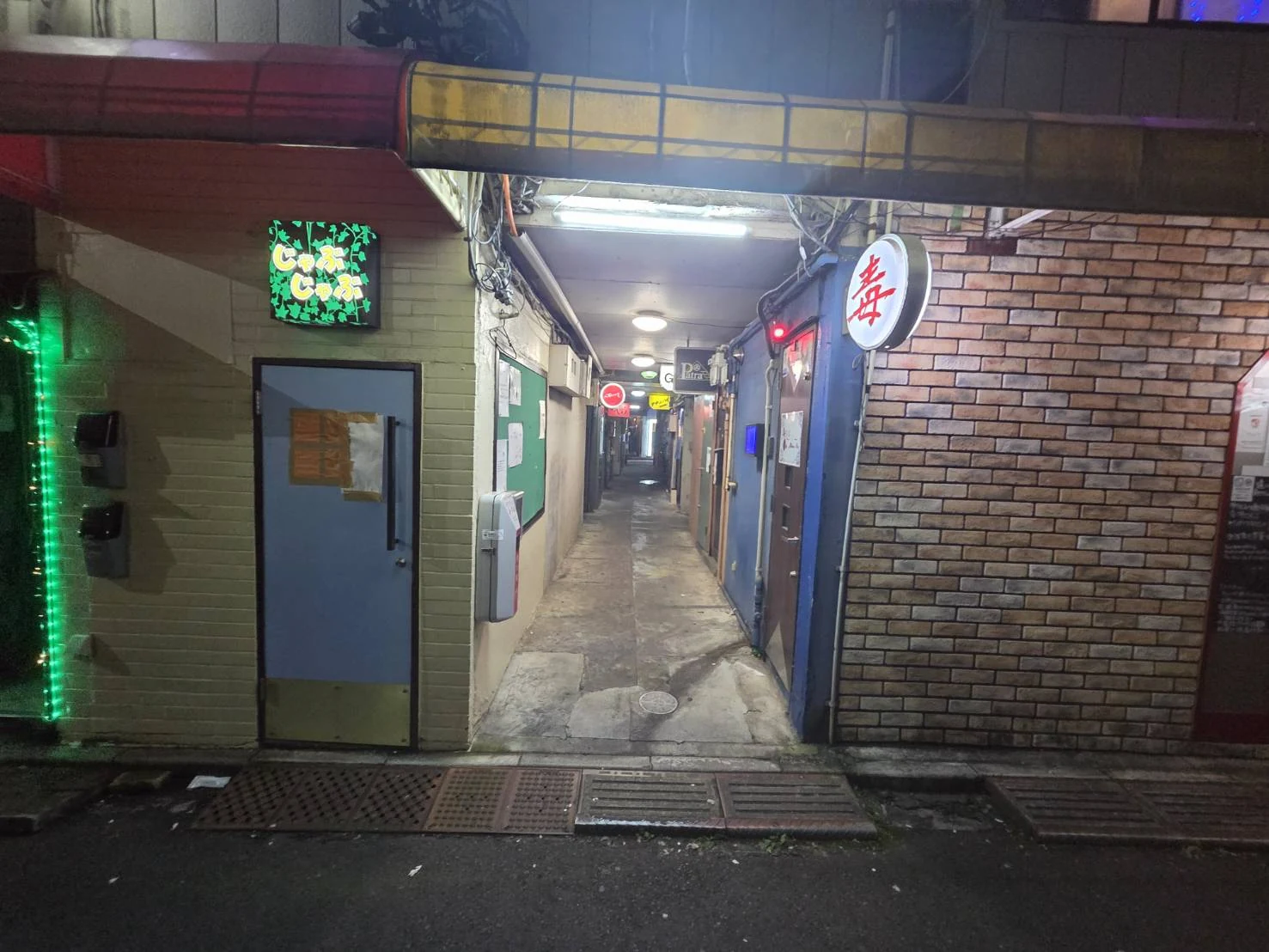
In Mukojima, the red-line district known as Hatonomachi and the Tamanoi area nearby became ordinary neighborhoods; some tiled buildings from the 1950s survive. In Shinjuku, the Ni-chome red-line district is now known for its small bars; how directly those bars descend from the red-line premises is something we could not document from primary sources. The neighborhood’s later history is its own story, closely tied to the growth of the entertainment district next door, which we trace in how Kabukicho was built from a burned field.
The move into bathhouses
The most consequential move was into bathhouses. Bathhouse-style businesses with private rooms predate the ban (our 1984 renaming article traces them to the early 1950s). The state responded not by banning them but by regulating them. Law No. 91 of 1966, an amendment to the entertainment-business law in force from July 1, 1966, defined for the first time “a business that establishes private rooms in bathhouse facilities and provides, in those rooms, services involving contact with customers of the opposite sex.” It barred these businesses from operating within 200 meters of schools, libraries, child-welfare facilities, and certain public buildings.
The law describes the business without calling it prostitution. Once a category exists in law, it can be zoned and regulated.
How 1958 Set Up the 1984 Entertainment Law
In 1984, the cabinet submitted a major revision of the old entertainment-control law. The National Diet Library index shows it was submitted on April 24, passed on August 8, and promulgated on August 14, 1984 as Law No. 76, with the new rules taking effect, under its supplementary provisions, on a cabinet-order date within six months. The law was renamed the Act on Control and Improvement of Amusement Business (風俗営業等の規制及び業務の適正化等に関する法律), usually shortened to Fueiho, and it gained a new chapter for “sex-related businesses” that included the bathhouse category defined in 1966.
The same year, the industry dropped its old name. The story of that change, prompted by a Turkish student’s protest, is told in our companion piece on the 1984 switch from “Turkish bath” to soapland. Today, the former Yoshiwara quarter is the best-known district for these bathhouses.
The Loophole That Remains Today
The basic design of 1956 is still in place. Selling and buying sex are prohibited without penalty. Solicitation, arranging, and running a business are crimes. And the bathhouse category, now called a “store-type sex-related special business” under Article 2, paragraph 6 of the Fueiho, is defined in the same words Japan’s lawmakers wrote in 1966. That business can operate legally within the zones and procedures the Fueiho sets. What happens inside a private room is, on paper, a separate question under the Anti-Prostitution Act.
This is what people mean when they call it a loophole. It follows from choices made in 1956: a narrow definition of prostitution, no penalty for the act itself, and penalties concentrated on third parties who must be proven to have arranged or managed it.
The 2024 reform of the protection chapter
The one part of the 1956 design that has changed fundamentally is the protection chapter. The Act on Support for Women with Difficult Problems (困難な問題を抱える女性への支援に関する法律), enacted in May 2022 as Law No. 52 of 2022, took effect on April 1, 2024. According to the Cabinet Office’s Gender Equality Bureau, it moved women’s support out of the Anti-Prostitution Act’s “protection and rehabilitation” framework and into a support framework. The prefectural counseling offices became Women’s Consultation Support Centers (女性相談支援センター), and the shelters became Women’s Self-Reliance Support Facilities (女性自立支援施設). The Ministry of Justice notes that the guidance-disposition system from 1958 was abolished as part of the same reform.
What this means for a visitor
For anyone reading this history from outside Japan, the practical lesson is caution, not curiosity. The absence of a penalty in Article 3 does not make the trade legal, and the businesses that operate at the edge of the law are exactly the places where the people who work there have the fewest protections. Solicitation on the street, touts, and “introduction” services are the conduct the law targets, and they are also where scams, overcharging, and exploitation are most common. The history of 1958 is a reason to keep distance from that world, not a guide into it.
→ Related, on the present day: what a Japanese “free information center” is.
Frequently Asked Questions
When did Japan abolish the red-line districts?
The Anti-Prostitution Act (Law No. 118 of 1956) was promulgated on May 24, 1956. Its main provisions took effect on April 1, 1957, and its penal chapter on April 1, 1958. The red-line districts lost their legal basis when the penalties began in April 1958.
Is prostitution illegal in Japan?
Yes. Article 3 of the Anti-Prostitution Act prohibits both selling and buying sex. But the act attaches no penalty to Article 3. The penalties apply to public solicitation, arranging prostitution, contracts, providing premises, and running the business.
Who pushed for the Anti-Prostitution Act?
Women legislators led the campaign. A 1955 bill was submitted by 19 women members of the House of Representatives, including Kamichika Ichiko, and was defeated 191 to 142. Upper-house members including Ichikawa Fusae, Miyagi Tamayo, and Akamatsu Tsuneko kept up the pressure until the cabinet submitted its own bill in 1956.
Why are there two different dates, 1957 and 1958?
The act’s supplementary provisions split its start: main provisions on April 1, 1957, and the penal Chapter 2 on April 1, 1958, giving businesses a year to close or convert.
Did the law affect geisha?
No. The law targets prostitution as it defines it, and geisha are professional entertainers. The two are often confused abroad; we explain the difference in our article on oiran and geisha.
What replaced the women’s counseling offices created in 1956?
Since April 1, 2024, they have operated as Women’s Consultation Support Centers under the Act on Support for Women with Difficult Problems (Law No. 52 of 2022), which moved women’s support out of the Anti-Prostitution Act.