Japan’s Free Information Centers: How to Use One Safely
A “free information center” (muryō annaijo, 無料案内所) is a staffed shopfront in Japan’s nightlife districts that tells you about hostess clubs, cabarets and similar venues, at no charge to you. In Tokyo these centers must notify the police before opening and follow a 2006 metropolitan ordinance on hours, signs and minors. That makes them a very different thing from a street tout, and for a first-time visitor they are a comparatively safe way to find a venue. Two things are worth knowing before you walk in. The service is free because the venues pay the center, and the bill is set by the venue, not the counter. So use the center to choose, then confirm the total price per person at the venue’s door before you sit down.
Below we explain what a center is, how it differs from a tout, how it earns money, what the Tokyo rules require, and a simple routine for using one. We do not name or locate any center or venue.
What a “free information center” is
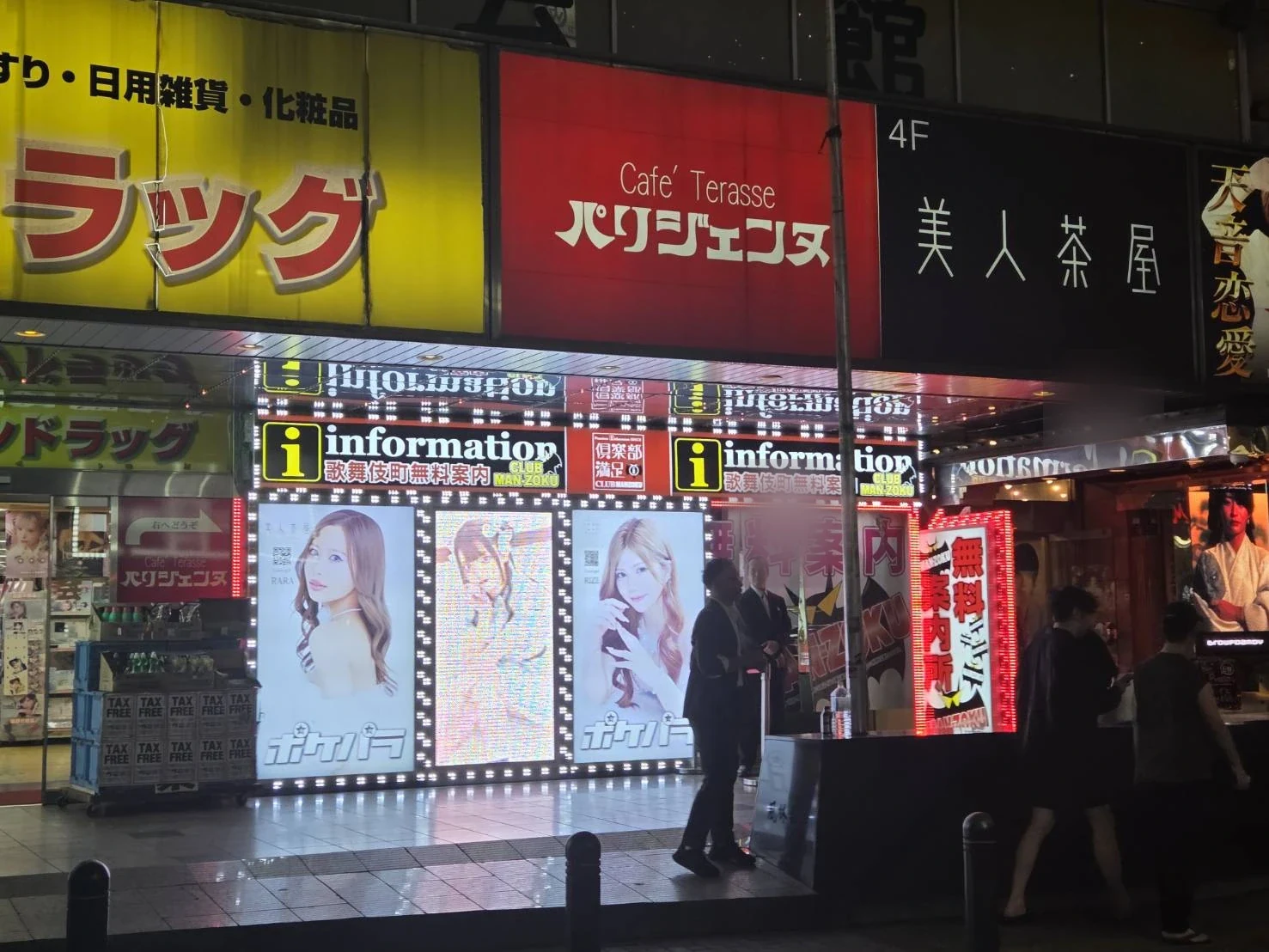
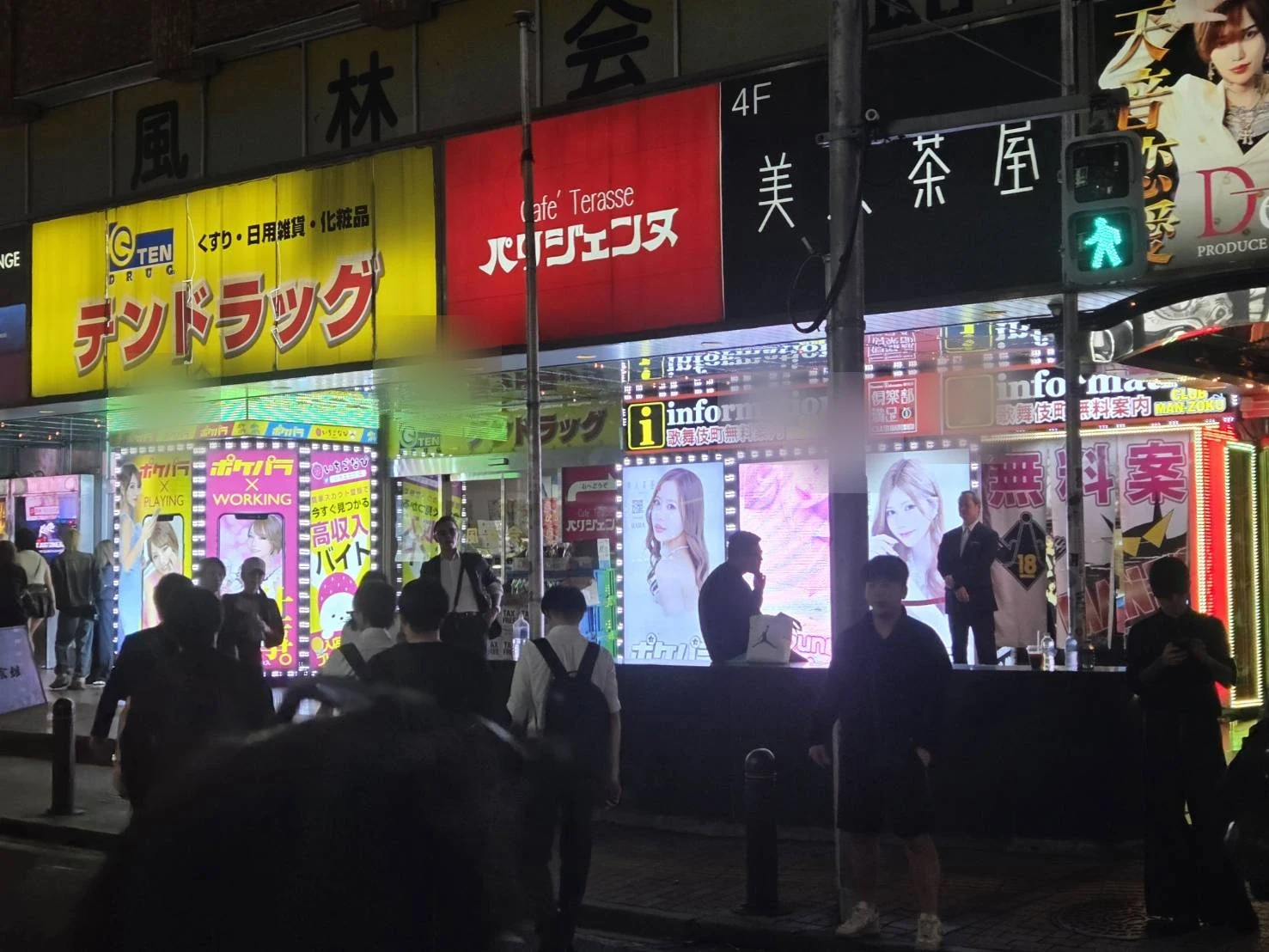
You will see them in big nightlife districts: small, brightly lit shopfronts with 無料案内所 (“free information center”) on the sign and staff at a counter. They do not book trains or sell sightseeing passes. They give information about nightlife businesses: what kinds of venues are nearby and roughly what they cost.
Tokyo’s law defines the activity precisely. The metropolitan ordinance calls it fūzoku annai (“adult entertainment guidance”): giving information, on request, about two kinds of business. One is businesses that offer physical-contact services in response to a customer’s sexual curiosity. The other is businesses that entertain customers and serve them food and drink in a way that creates a festive, pleasure-oriented atmosphere, which covers hostess clubs and cabarets (Tokyo Metropolitan Government, Ordinance No. 85 of 2006, Article 2). The definition applies whether the information is given “for a fee or free of charge.”
The choice they help with is large. The National Police Agency counted 76,859 licensed entertainment businesses in Japan at the end of 2024, including 59,516 in the category that covers cabarets and hostess clubs (NPA, 2024 report on entertainment businesses, PDF in Japanese). For a visitor with no Japanese and no local contacts, a counter that narrows that down is genuinely useful.
→ For how Japan came to regulate these categories, see the 1958 law that closed the red-line districts and what “red line” and “blue line” meant.
How to tell it from a tourist information center
Japan has a separate national system for tourist offices. The Japan National Tourism Organization (JNTO) certifies them in three categories plus “partner facilities,” and says more than 1,500 centers have been approved since the program began in 2012. Certification lasts three years, and every Category 1 to 3 center displays the JNTO symbol (JNTO, TIC Certification Program). If a counter on a nightlife street has no JNTO symbol and shows club signs in the window, it is a muryō annaijo. Go to a JNTO-certified center for trains and sightseeing, and to a muryō annaijo for nightlife.
Why a center is a safer bet than a street tout
The person to avoid in a nightlife district is not the center. It is the tout: someone who approaches you on the street and offers to take you to a bar. Tokyo police advise foreign visitors plainly: “Do not follow street touts under any circumstance.” The same page explains why: some touts “lure you to their partner bars, and while you are drunk, charge excessive fees or use your credit card without your knowledge” (Tokyo Metropolitan Police Department (MPD), tips for foreign visitors). The U.K. government gives the same advice: “Do not follow street touts into bars” (GOV.UK, Japan safety and security).
Some wards back this up in their own ordinances. Shibuya, for example, prohibits touting and waiting for customers in public places outright — see what is actually banned in Shibuya on Halloween.
A center works the other way round. You choose to walk in, it has a fixed address, and the law knows who runs it.
| Free information center (Tokyo) | Street tout | |
|---|---|---|
| Where | A fixed shopfront you choose to enter | Approaches you on the street |
| Police paperwork | Must notify police 10 days before opening, for each location (Ordinance No. 85, Art. 3) | None; touting for licensed venues is itself banned (Amusement Business Act, Art. 22) |
| Rules on conduct | Set hours, limits on noise and window displays, no minors (Art. 4) | In Shinjuku, touting and loitering to tout are banned by ward ordinance |
| Records | Must verify each venue it works for by documents and keep them 3 years (Art. 7) | None |
| Police advice | No warning against centers found in the police pages we read | “Do not follow street touts under any circumstance” (MPD) |
We found no statistics comparing harm from centers with harm from touts, so this is a judgement based on how the two are regulated, not a measured rate. It is also not a guarantee: a center tells you about venues, but it does not run them.
How a center makes money
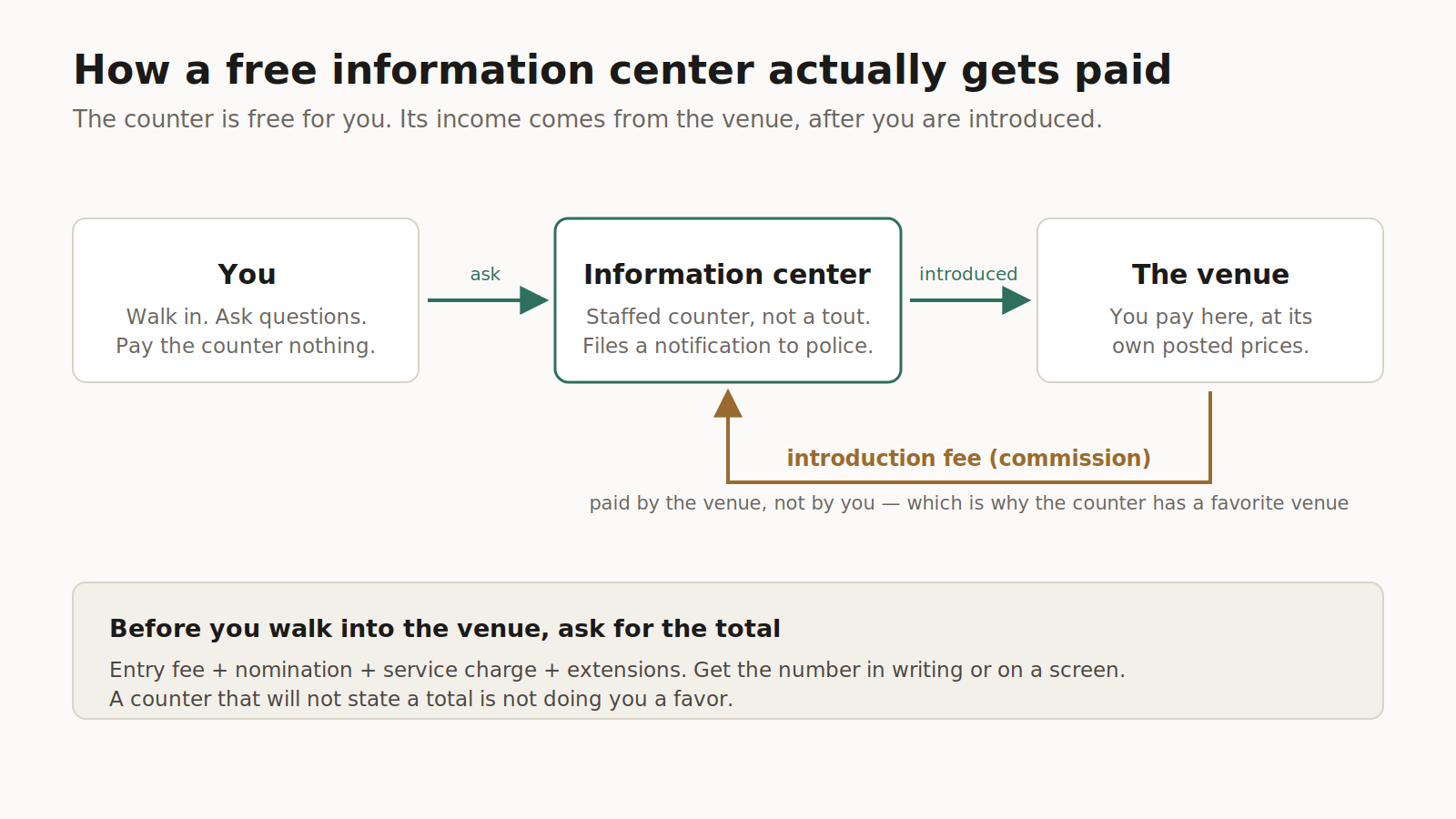
You pay nothing at the counter. The venues pay the center. We found no official statistics on these fees, so the details in this section come from Japanese nightlife-industry websites, which are secondary sources. Treat them as the industry’s own description, not verified figures.
- Advertising fees. A Japanese hostess-club job site says shops pay the center an advertising fee, which is why customers pay nothing (Tainew.com glossary, industry site).
- Referral fees. A site for nightlife recruiters describes the shop paying the center a referral fee in exchange for guiding customers to it (Recruit Manager, April 2025, industry site).
The official text points the same way without naming any fee. Article 7 of Tokyo’s ordinance says that when a center is “entrusted” with guidance by a business, it must check documents proving who that business is, the venue’s name and address, and its business type, and keep those records for three years (Ordinance No. 85, Article 7). In other words, the law expects centers to work on behalf of venues, and it requires them to know who those venues are.
| How the center earns | Who pays | What it means for you | Source |
|---|---|---|---|
| Advertising or listing fee | The venue | The list you see is the venues that work with that center | Industry site (secondary) |
| Referral fee | The venue | Staff are paid to send you somewhere, so ask about price as well as atmosphere | Industry site (secondary) |
| Fee charged to you at the counter | — | None found. The service is free to you | Industry sites (secondary) |
English-language nightlife sites quote specific per-person commissions. We could not verify any figure from a Japanese or official source, so we do not repeat them. Being paid by the businesses it recommends is how a referral service works, and it is not in itself a reason to avoid a center. Unseen Japan’s summary is fair: “Most of these stores aren’t scam shops. All of them, however, take kickbacks from referral stores” (Unseen Japan). The practical point is simple: the counter’s job is to match you with a venue, and the price you pay is set by that venue.
What Tokyo’s 2006 ordinance requires
Tokyo’s rule has a long official name: the Ordinance on the Prevention of Adult Entertainment Guidance That Excessively Promotes a Pleasure-District Atmosphere (歓楽的雰囲気を過度に助長する風俗案内の防止に関する条例). It was promulgated on March 31, 2006, and took effect on June 1, 2006 (Tokyo Metropolitan Government legal database). Its stated purpose, in Article 1, is to protect young people from things that harm their healthy development and to support sound neighborhoods in entertainment districts. It is not a consumer-protection law.
| Rule | Article | What it says (summary) |
|---|---|---|
| Notification | 3(1) | Notify the Tokyo Public Safety Commission at least 10 days before starting, for each location |
| Under-18 sign | 3(3) | Post a sign at the entrance saying people under 18 may not enter |
| Hours | 4(i) | No guidance from midnight to 6:00 a.m. (from 1:00 a.m. in areas set by commission rules) |
| Noise | 4(ii) | No noise above limits set by commission rules |
| Window displays | 4(iii), 4(iv) | No photos or pictures of the venues’ services visible from outside; no sexually suggestive text or symbols |
| Ads for sexual-contact businesses | 4(v), 4(vi) | In the areas in the Appended Table, no ads for these businesses inside or outside the center, and no handing out their flyers |
| Minors | 4(vii), 4(viii) | No staff under 18 dealing with customers; no customers under 18 |
| Records | 6, 7 | Keep a staff register; verify each client venue by documents and keep them 3 years |
| Enforcement | 5, 8 | Orders to stop violations; reports and on-site inspections |
The Appended Table is broader than it looks. Its first item is all of Tokyo except blocks 16 to 32 and 41 to 48 of Senzoku 4-chome in Taito Ward; its second is the area within 200 meters of schools, libraries, child welfare facilities, hospitals and clinics with inpatient beds (Ordinance No. 85, Appended Table). So in almost all of Tokyo, a center may not display ads for sexual-contact businesses or hand out their flyers. We did not find data on how the police enforce these rules in practice.
Penalties are set in Article 10. Using minors, or ignoring an order from the Public Safety Commission to stop a violation, can bring up to six months’ confinement or a fine of up to ¥500,000. Breaking the advertising and flyer rules carries a fine of up to ¥500,000; failures in notification, the staff register or venue checks, up to ¥300,000; and obstructing reports or inspections, up to ¥200,000. The ordinance was last amended by an ordinance that took effect on June 1, 2025.
What the ordinance does not do
It does not license centers. They file a notification, which the MPD accepts at the local police station (MPD, notification of adult entertainment information centers). It does not set or check prices. And unlike Kyoto Prefecture’s ordinance, which bars centers within 200 meters of schools, hospitals, parks and similar facilities (Kyoto Prefecture Ordinance No. 22 of 2010), Tokyo’s text contains no zone where a center itself may not open. Its 200-meter zones limit advertising, not location.
Why Tokyo wrote a special rule
The pressure came from Shinjuku. On December 6, 2005, the Shinjuku City Assembly sent the Governor of Tokyo a formal request for an ordinance. It complained that centers in Kabukicho used flashing decorative lights and loud in-store announcements, and that some displayed photos of hostesses visible from the street, which it saw as a problem for young people. It also noted that “there is currently no ordinance that can effectively regulate them” (Shinjuku City Assembly, written opinion, December 2005, PDF in Japanese). The rules on lights, noise and window photos in the 2006 ordinance answer those complaints directly.
→ For how the district itself came to be, see how Kabukicho became Kabukicho.
That gap existed because the national law does not cover these centers. Japan’s main entertainment law, the Act on Control and Improvement of Amusement Business (Act No. 122 of 1948), regulates licensed venues and adult businesses. A Japanese administrative-law office that handles these filings summarizes the position: information centers are not regulated by the national act but by some prefectures’ own ordinances (Sato Administrative Scrivener Office).
The rules that protect you at the venue
Your protections as a customer mostly apply to the bar or club you end up in, and to anyone who tries to pull you there on the street.
| Law | Who it binds | What it bans or requires | Penalty |
|---|---|---|---|
| Amusement Business Act, Art. 22(1)(i)-(ii) and Art. 53 | Licensed entertainment venues | Touting, and blocking or following people on the street to tout | Up to 6 months’ confinement or ¥1,000,000 fine, or both |
| Amusement Business Act, 2025 amendment | Hostess-type venues | False explanations about prices added to the rules venues must follow | Not stated in the NPA summary |
| Tokyo Ordinance No. 196 of 2000 (anti-rip-off), Arts. 3-4 and 11 | Designated adult and hostess-type venues (price posting); anyone soliciting or collecting for them | Post prices inside; no luring with misleadingly low prices; no rough or coercive collection | Up to 6 months’ confinement or ¥500,000 fine for breaking Art. 4 |
| Shinjuku City touting ordinance | Anyone touting in public places in the ward | Touting, street scouting, and loitering to wait for targets | Warnings, public naming, non-criminal fine up to ¥50,000 |
The touting ban and its penalty come from the national act’s Articles 22 and 53 (e-Gov, Act No. 122 of 1948). The 2025 amendment was promulgated on May 28, 2025, and took effect on June 28, 2025 (Kyoto Prefectural Police). The National Police Agency’s summary lists “false explanations about prices” as a new rule for hostess-type venues (NPA, amendment summary, PDF in Japanese). Tokyo’s anti-rip-off ordinance requires designated venues to post their prices where customers can see them (Article 3), bans anyone who solicits for them from making prices sound far lower than they are, and bans rough collection (Article 4); breaking Article 4 carries up to six months’ confinement or a ¥500,000 fine (Article 11) (Tokyo Ordinance No. 196 of 2000). Shinjuku’s touting ordinance took effect in September 2013, and its penalties have applied since June 1, 2016 (Shinjuku City; Shinjuku City press material).
Police do use these laws. In 2024, police nationwide cleared 124 cases of touting and street-following under the national act, involving 200 people (NPA, 2024 report).
How to use a center well
Where visitors do get hurt in Tokyo nightlife, governments point to venues and touts. The U.K. government says most British victims of drink spiking and credit-card fraud were targeted in Kabukicho, and advises: “Ensure you see a menu with prices before you enter a bar or restaurant” and “Keep track of what you order and confirm the price of admission to clubs on entry” (GOV.UK). The U.S. State Department reports citizens being “forced to take money out of ATMs or being robbed because they couldn’t pay large bar tabs” (U.S. State Department, Japan). Neither mentions information centers. A short routine covers the gap between the counter and the bill.
Deal with the counter, not the street
Get your information from the staff inside the center, and walk to the venue yourself or with someone the counter clearly sends. If a stranger outside offers you a better deal, that is a tout, and you should not follow them. A Shinjuku lawyer who handles overcharging cases published one from May 2016 that shows why. A customer asked at a center in Kabukicho, and a second man then promised a price of ¥9,000 with “no extra charges at all.” The customer was taken to a different kind of venue from the one he asked for and told a ¥30,000 table charge had built up. When he went back to complain, a man at the center said the other man was a street tout unrelated to the center. The customer had paid ¥12,000 in total; when he started calling the police outside the building, the venue handed back ¥12,000 (Aoshima Katsuyuki law office, in Japanese). This is one case, not a rate. Its lesson is the one the police give: do not go with someone who joins you from the street.
Confirm the total at the door
Ask the counter for a total, then confirm the same total at the venue’s door before you sit down. If the door price differs from the counter’s, leave. You have not agreed to anything yet. The questions below take a minute.
| Ask before you go | Why it matters |
|---|---|
| What is the total per person, including table or seat charge, service charge and tax? | A total is easier to check at the door than a base price |
| How long does that price cover, and what happens after? | So the end of the time you paid for is not a surprise |
| Which drinks does the price include? | Shinjuku Police note that some drinks are not included in all-you-can-drink plans |
| Can I see the price list in writing, or photograph it? | Designated venues must post their prices inside |
| Who will take me there, and do they work for you? | Someone who joins you on the street may be a tout |
Shinjuku Police Station also tells people to check which drinks an all-you-can-drink plan covers, and to look up a venue’s online reviews before choosing it (Shinjuku Police Station, in Japanese). Once inside, keep track of what you order, do not leave your drink unattended, and keep your card where you can see it.
This guide is published by the team behind Pianissimo, a Tokyo outcall service. If you would rather book in English in advance than walk into a counter, our contact and reservations page lists the messaging apps our English-speaking staff answer.
If the bill is wrong
- You feel threatened, or they will not let you leave: call 110. The MPD says that if you do not speak Japanese, “a police interpreter will be on the line to assist you” (MPD, how to contact the police).
- Not an emergency: #9110. The MPD says its General Advisory Center “will help you find who to contact.”
- A price dispute after the fact: the Consumer Hotline for Tourists, 03-5449-0906, weekdays 10:00 a.m. to noon and 1:00 to 4:00 p.m., in English and six other languages. It handles consumer issues only and has no power to order a business to pay (National Consumer Affairs Center of Japan).
- Help at any hour: JNTO’s Japan Visitor Hotline, 050-3816-2787, 24 hours a day, in English, Chinese and Korean (JNTO).
- Report before you fly home. The U.S. State Department notes that Japanese police cannot accept reports filed from abroad.
What we could not confirm
- Any official figure for referral or advertising fees. The amounts on English-language sites have no source we could check, and the Japanese sources we found are industry sites.
- How centers compare with touts in measured harm. We found no statistics; our view rests on how the two are regulated.
- How many centers operate in Tokyo. We found no published count from the MPD or the Tokyo government.
- Which areas get the 1:00 a.m. closing time. The ordinance refers to commission rules, and we could not identify the areas in the rules we opened.
- How often the ordinance is enforced. The national police report we read does not break out information-center cases.
Frequently asked questions
Are free information centers in Japan safe?
As a way to find a venue, generally yes, and far safer than following a street tout, which Tokyo police say never to do. In Tokyo, centers must notify the police and follow a 2006 ordinance. The venue you are sent to sets the bill, so confirm the total per person at the door before you sit down.
How do free information centers make money?
From the venues, not from you. Japanese industry sites describe advertising fees and referral fees paid by bars and clubs. We found no official data on the amounts.
Are free information centers legal in Tokyo?
Yes, if they follow Tokyo’s 2006 ordinance. It requires a notification to the police 10 days before opening, bans guidance from midnight to 6:00 a.m. (from 1:00 a.m. in some areas), and bans minors as staff or customers. The ordinance applies whether the service is free or paid.
Is a free information center the same as a tourist information center?
No. Category 1 to 3 tourist information centers certified by JNTO display the JNTO symbol and help with travel. A free information center gives information about nightlife venues such as hostess clubs and is paid by those venues.
What should I do if a venue charges more than the center quoted?
If you feel threatened or cannot leave, call 110; an interpreter can join. For a dispute after the fact, call the Consumer Hotline for Tourists on weekdays. File any police report before leaving Japan.
Can I bring a friend under 18 into a free information center?
No. Tokyo’s ordinance bans centers from letting anyone under 18 in as a customer and requires a sign at the entrance saying so.