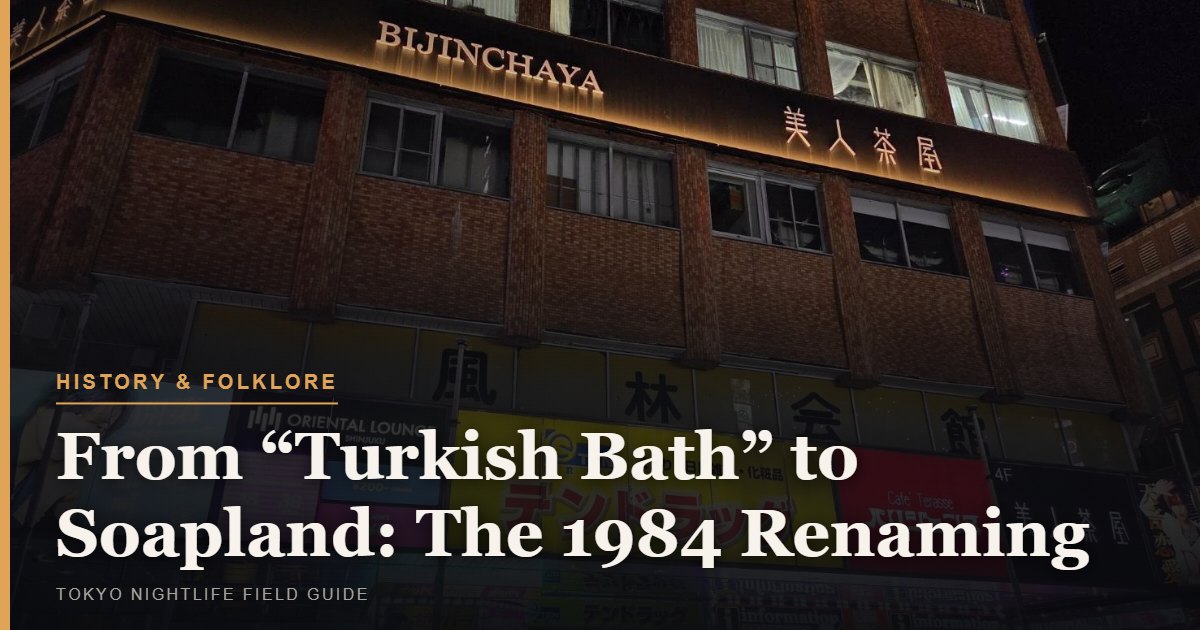
From “Turkish Bath” to Soapland: The 1984 Renaming
On December 19, 1984, at a press conference in the Akasaka Prince Hotel in Tokyo, a trade association announced that the businesses Japan had called toruko-buro — “Turkish baths” — would from then on be called soapland. The story is usually told as a diplomatic anecdote: a Turkish student objected, and a new word was coined. That version is true as far as it goes, and almost every English-language account stops there.
It misses the more interesting fact. Four months earlier, on August 14, 1984, Japan had already promulgated the law that would reorganise the whole sector — and it was due to take effect on February 13, 1985, eight weeks after the press conference. The industry was not only changing a name. It was choosing the name it wanted to be carrying when the new rules arrived.
The name is younger than the business
“Soapland” is wasei-eigo — English words assembled in Japan, for Japan. It is built from sekken no kuni, “soap country”, and it has no currency in English outside the Japanese context. It is also a good deal younger than the thing it describes. The business it names had been operating for more than three decades under a different label, and under a legal framework that had already been rewritten twice before anyone thought to change the sign on the door.
The sequence matters, because the two are constantly confused. The 1984 renaming changed what the business was called. It did not change what the business was, where it could operate, or how it was regulated. Those changes happened in 1966 and in 1985, for reasons that had nothing to do with Turkey.
What this article covers, and what it does not
This is a history of a legal category and a word, from 1951 to 1985, with a short note on where the numbers stand today. It is not a guide to the businesses themselves. It does not name establishments, give locations beyond the district level that appears in public statistics, or discuss prices or services.
April 1951: a bathhouse in Ginza
The lineage begins with an ordinary commercial idea. In the early postwar years, a trip to the hot-spring resorts at Atami or Hakone was out of reach for most Tokyo residents. In April 1951 a facility called Tokyo Onsen opened in Ginza, offering an approximation of that experience in the middle of the city.
The Japan Sauna & Spa Association’s own newsletter later quoted the founder’s son on the reasoning: in a period when getting to Atami or Hakone was impractical, his father thought central Tokyo could use a substitute (Sauna Association newsletter, August 15, 2004). Later accounts date the first “Turkish bath” service, a private steam bath, to Tokyo Onsen (Unseen Japan).
A label that stuck
The label soon attached itself, in ordinary Japanese usage, to something quite different from a hammam — and that gap is the whole of the later dispute.
Why a bathhouse, of all things?
This is the question the English-language accounts skip, and it has a precise answer. Japan had a licensing regime for bathhouses that predated the postwar sex-industry settlement, and that regime was administratively separate from the one that governed nightlife. Public baths were licensed under the Public Bath House Act of 1948 (Act No. 139 of 1948), administered by health authorities. Nightlife venues were controlled under the Businesses Affecting Public Morals Control Act of 1948 (Act No. 122 of 1948), administered by the police.
That separation became commercially significant after 1958. When the penal provisions of the 1956 Anti-Prostitution Act came into force on April 1, 1958, the akasen red-line districts lost their legal cover and closed as a recognized category. The demand did not disappear, and neither did the operators. A license issued by a health department, for a category of premises the police did not license, was an attractive place to reorganise.
The pattern, in one sentence
The bathhouse category was not chosen because bathing was the point; it was chosen because it was the door that was open. The same logic — reclassify rather than close — recurs throughout the regulatory history of the sector, and it is the reason Japanese law still describes these premises in the vocabulary of plumbing.
1966: the law gives the arrangement a name
By the mid-1960s the arrangement was conspicuous enough that the legislature addressed it directly. Act No. 91 of June 30, 1966 amended the 1948 morals-control statute and inserted a new Article 4-4, which defined the business as:
浴場業(公衆浴場法(昭和二十三年法律第百三十九号)第一条第一項に規定する公衆浴場を業として経営することをいう。以下同じ。)の施設として個室を設け、当該個室において異性の客に接触する役務を提供する営業(以下「個室付浴場業」という。)
— a bathhouse operation that provides private rooms in which services involving physical contact with customers of the opposite sex are offered; hereafter, “private-room bathhouse business” (House of Representatives, Act No. 91 of 1966).
The wording has proved durable. Nearly the same sentence is still in force today, as Article 2, paragraph 6, item 1 of the current Act:
浴場業(公衆浴場法(昭和二十三年法律第百三十九号)第一条第一項に規定する公衆浴場を業として経営することをいう。)の施設として個室を設け、当該個室において異性の客に接触する役務を提供する営業 (e-Gov, Act No. 122 of 1948, art. 2(6)(i)).
The administrative plumbing
Five weeks after the 1966 amendment, the Ministry of Health and Welfare told prefectural health departments how to handle it. Notice Kan’ei No. 5091 of August 5, 1966 instructed that when an application for a private-room bathhouse license arrived, the health bureau was to query the police-side bureau in writing and before examining the application, to establish whether the business fell within the new Article 4-4 (MHLW, Notice Kan’ei No. 5091).
Two ministries, one counter, one business. That divided supervision is the structural reason the sector was so hard for any single authority to move against — as a case from Yamagata showed.
The playground case
A company planned to open a private-room bathhouse in Amarume, a town in Yamagata Prefecture. The prefectural governor then authorised a children’s playground close to the planned site.
The distance was not incidental. Under the 1966 amendment, proximity to a child-welfare facility could block the business. The company opened anyway, and a prosecution under the morals-control statute followed.
What the Supreme Court held
On June 16, 1978 the Second Petty Bench of the Supreme Court held that the governor’s authorisation of the playground amounted to an abuse of administrative power, and so had no effect to restrict the business (Keishū vol. 32, no. 4, p. 605; Yuhikaku case record).
The ruling is now a standard case in Japanese administrative-law teaching, cited for the proposition that a formally valid administrative act can lose its effect where its real purpose is improper. For this history, its significance is narrower and sharper: by 1978 the courts had made clear that local government could not zone the sector out of existence by improvisation. If the category was going to be constrained, it would have to be done by statute.
August 1984: the law changes first
It was. Act No. 76 of 1984 passed the Diet on August 8, 1984 and was promulgated on August 14, 1984; the National Diet Library’s legislative index records it as a Cabinet bill submitted to the 101st session on April 24, 1984, amending four statutes including the 1948 morals-control Act, the Hotel Business Act, the Child Welfare Act and the Building Standards Act (NDL, Act No. 76 of 1984).
Its effects were substantial. The statute’s own title changed, from the “Businesses Affecting Public Morals Control Act” to the “Act on Control and Improvement of Amusement Business, etc.” — a shift from policing to licensing-and-supervision that signaled the whole approach. A new umbrella category, fūzoku kanren eigyō (“morals-related businesses”), was created, bringing the private-room bathhouse business and four other formats under one notification regime (House of Representatives, Act No. 76 of 1984). The amended Act took effect on February 13, 1985 (National Police Agency, 1986 White Paper), with the implementing rules issued as National Public Safety Commission Rule No. 1 of January 11, 1985.
Why this is the part that matters
Every English-language account of the renaming treats December 1984 as the beginning of the story. By December 1984 the law had been on the books for four months and was eight weeks from taking effect. An industry about to be brought under a new notification regime, under a statute retitled around “proper operation”, had a concrete reason to want a clean word on its signage — separate from, and additional to, the diplomatic complaint it was fielding.
| Date | Event | Instrument |
|---|---|---|
| 1948 | Public bath houses brought under a health-side license | Public Bath House Act (Act No. 139 of 1948) |
| 1948 | Nightlife venues brought under a police-side license | Act No. 122 of 1948 |
| April 1951 | Tokyo Onsen opens in Ginza; “Turkish bath” service marketed | — |
| April 1, 1958 | Penal provisions of the 1956 Anti-Prostitution Act take effect; red-line districts close | Act No. 118 of 1956 |
| June 30, 1966 | “Private-room bathhouse business” defined in statute (new art. 4-4) | Act No. 91 of 1966 |
| August 5, 1966 | Health bureaus ordered to clear license applications with police bureaus | MHLW Notice Kan’ei No. 5091 |
| June 16, 1978 | Supreme Court: blocking the business via a playground designation is an abuse of power | Keishū 32-4-605 |
| August 14, 1984 | Major amendment promulgated; Act retitled; “morals-related businesses” created | Act No. 76 of 1984 |
| December 19, 1984 | Trade association announces the name “soapland” | — |
| February 13, 1985 | Amendment takes effect | Act No. 76 of 1984 |
The student who would not let it go
The diplomatic thread runs in parallel. Nusret Sancaklı, a Turkish national who had come to Japan in 1981 as an exchange student in earthquake studies, objected to his country’s name being attached to the businesses. Accounts of his campaign describe him lobbying politicians and journalists to explain what a hammam actually is (Mainichi profile, via debito.org).
In 1984, according to Unseen Japan, he petitioned the Minister of Health and Welfare, Watanabe Kōzō, to drop the use of his country’s name. The same account adds that the Turkish embassy had lodged its own complaint after a Shinjuku business turned up in a phone listing under a name that read as “Turkish Embassy” (Unseen Japan). Unseen Japan also reports that Koike Yuriko, then a journalist and later a politician, helped publicise the campaign.
December 19, 1984, Akasaka Prince Hotel
The Tokyo Special Bathhouse Association ran a public solicitation for a new name, announced in the Yomiuri Shimbun of November 16, 1984. Tokyo Reporter puts the number of entries at about 2,200; we have not found a primary record of the figure.
On December 19, 1984 the association held a press conference at the Akasaka Prince Hotel and announced the winner (Tokyo Reporter). Officials said they picked “soapland” for its “bright and clean image”.
| Name submitted | Literal sense | Outcome |
|---|---|---|
| Soapland | from sekken no kuni, “soap country” | Selected |
| Roman-buro / Romance Bath | “romance bath” | Runner-up |
| Ukiyo-buro | “floating-world bath” | Runner-up |
| Lovely Bath | — | Submitted |
| Colt | — | Submitted |
| Toriko | “prisoner” | Submitted |
| Love You / Honey | — | Submitted |
Where the accounts disagree
English coverage of this event is unusually inconsistent, and it is worth saying so plainly. ZOOM JAPAN dates the renaming to 1985 rather than 1984 (ZOOM JAPAN). The dates that are firmly documented are the legal ones — August 14, 1984 and February 13, 1985 — because they sit in the statute book.
February 1985: the new rules arrive
The amendment took effect on February 13, 1985. Under the new framework, private-room bathhouse operators filed notifications with the Public Safety Commission as a “morals-related business”.
Why the vocabulary of plumbing survives
Because the statute never abandoned it. The current Act still defines the category by reference to the Public Bath House Act, forty years after the word “bath” stopped doing any descriptive work. The legal fiction that the premises are baths, and that whatever else occurs there is a private matter between adults, is the load-bearing element of the entire arrangement — and it is why a business Japan renamed in 1984 is still, in law, a bathhouse in 2026.
What the name did, and did not, change
The renaming was a success on its own terms. The word toruko-buro disappeared from signage: in the words of a later Mainichi profile, “within a few months all ‘Toruko’ signs were gone” (via debito.org). A grievance that had reached the level of embassy complaint was settled by the industry itself.
What it did not do is change the business, its legal basis, or its scale. The count of establishments tells that story better than any adjective:
| Year | Establishments (nationwide) | Source type |
|---|---|---|
| FY2003 | 1,373 (private-room bathhouse businesses) | Primary — MHLW health administration report |
| End 2020 | 1,207 | Primary — National Police Agency |
| End 2023 | 1,211 | Primary — National Police Agency |
| End 2024 | 1,201 | Primary — National Police Agency |
The National Police Agency’s April 2025 report puts 1,201 type-1 storefront sex-related special businesses at the end of 2024, out of 6,651 storefront businesses of all types and 22,761 non-storefront businesses (NPA, April 2025). The Ministry of Health, Labour and Welfare’s own series recorded 1,373 private-room bathhouse businesses in FY2003 (MHLW). Forty years after the renaming, the category is vastly outnumbered by non-storefront formats.
The one-line version
A word chosen by public competition in December 1984 is now the standard term for a category of business defined by a sentence written in June 1966 and regulated by a statute that took effect in February 1985. The diplomacy is the memorable part of the story. The statute book is the part that explains what you can still see today.
Frequently asked questions
Why were soaplands called “Turkish baths”?
The label dates from 1951, when a Ginza bathhouse called Tokyo Onsen is reported to have offered a private “Turkish bath” steam service. It stuck to a business that had little to do with a hammam.
When did the name change to “soapland”?
On December 19, 1984, when the Tokyo Special Bathhouse Association announced the result of a public naming competition at a press conference in Tokyo. Some English sources give 1985; that appears to be an error.
Who chose the name “soapland”?
The trade association selected it from public submissions sought in the Yomiuri Shimbun of November 16, 1984. Tokyo Reporter puts the number of entries at about 2,200; no primary record of the figure has been located.
Is a soapland legally a bathhouse?
Yes, in form. Article 2(6)(i) of Act No. 122 of 1948 defines the category by reference to the Public Bath House Act of 1948, as a bathhouse operation with private rooms in which contact services are provided.
What changed in 1985?
The 1984 amendment, in force from February 13, 1985, placed the category under a notification regime as one of five “morals-related businesses”.
How many are there in Japan today?
The National Police Agency counted 1,201 type-1 storefront sex-related special businesses at the end of 2024, down from 1,211 a year earlier.